
Budgeting for Tree Removal and Stump Grinding Services
Key Factors Determining Your Tree Trimming Cost Estimate
When you request a tree trimming cost estimate, contractors evaluate several distinct factors to determine the overall price. While height provides a foundational starting point, local site conditions and structural risks heavily influence labor time and equipment choices.
- Tree Height and Canopy Overhead: Taller trees require specialized gear, harness climbers, or aerial lifts. Trimming a 70-foot canopy demands significantly more setup and safety rigging than shaping an eye-level ornamental tree.
- Site Accessibility: A front yard tree accessible directly by a bucket truck costs less to service than a backyard tree tucked behind a narrow fence, steep slope, or tight garden gate. If crew members must climb manually or haul limbs by hand, labor fees increase.
- Hazard Risk and Rigging Complexity: Branches hanging directly over roofs, solar panels, glass greenhouses, or active utility lines require delicate rope rigging. Crew members must lower heavy limbs piece by piece to avoid property damage.
- Labor Rates and Crew Size: Professional tree service labor generally ranges from $35 to $70 per hour per crew member, with average national hourly crew rates running around $63 per hour (typically spanning $50 to $75 per hour). Highly complex jobs requiring an ISA Certified Arborist command higher expert rates.
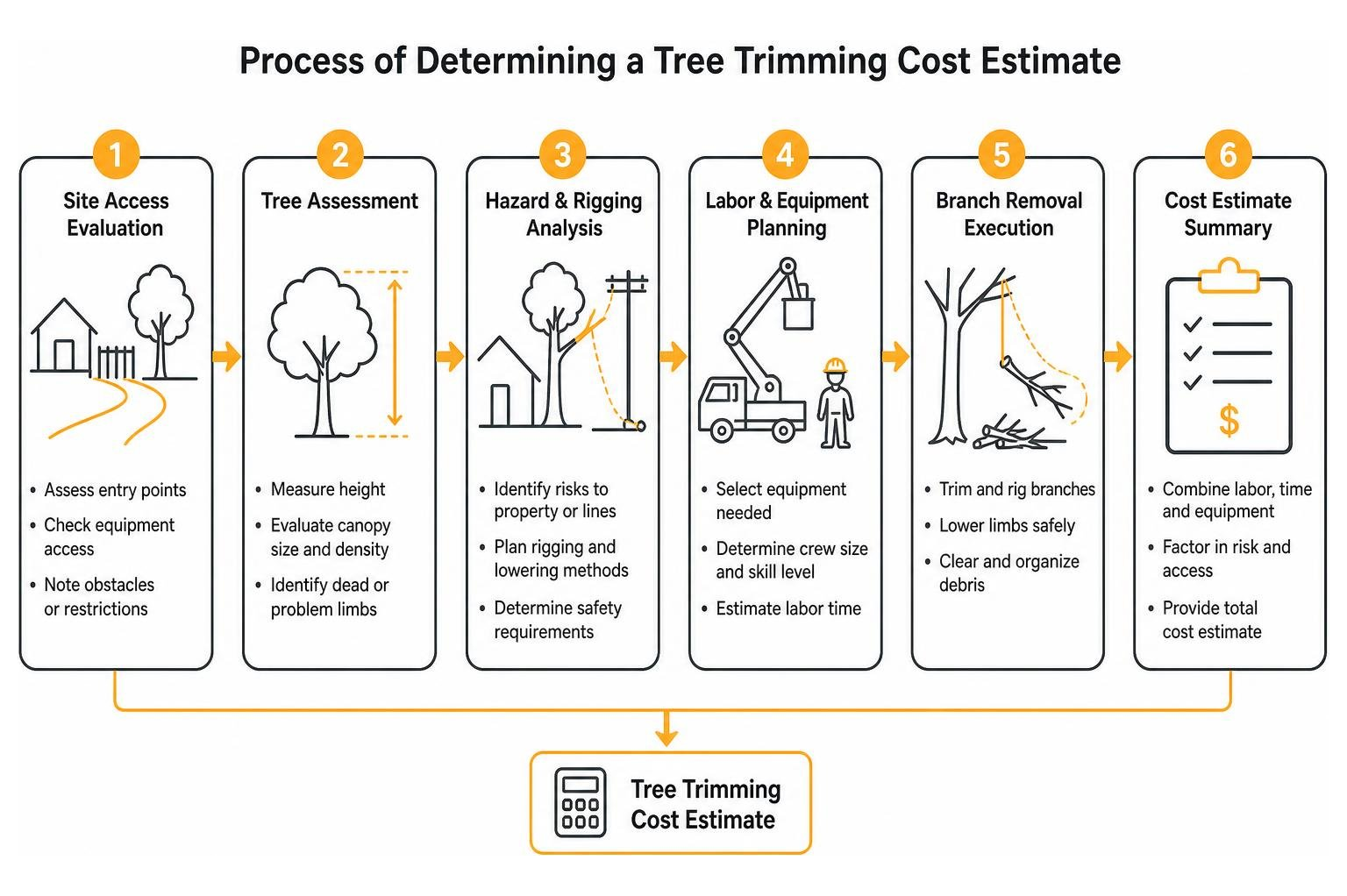
To help you budget accurately, here is a detailed breakdown comparing standard national pricing brackets based on tree size and project scope:
| Tree Category | Average Height | Estimated Price Range | Project Scope & Requirements |
|---|---|---|---|
| Very Small | Under 20 ft | $75 – $300 | Ground-level pole saws, basic hand pruning, light shaping |
| Small | 20 to 25 ft | $80 – $350 | Basic ladders, light canopy thinning, low branch clearance |
| Medium | 25 to 50 ft | $150 – $800 | Bucket truck access, moderate limb removal, structural pruning |
| Large | 50 to 60 ft | $300 – $1,800 | Manual harness climbing, heavy branch rigging, crown reduction |
| Extra-Large | 60+ ft | $700 – $2,000+ | Cranes, multi-person climbing crews, heavy hazardous removal |
How Tree Size and Species Impact Your Tree Trimming Cost Estimate
The specific species of your tree plays a direct role in structural wood density, growth habits, and total branch mass. Hardwoods and dense evergreens require more heavy-duty equipment and physical labor to cut and trim than lighter softwoods.
- Oak Trees: Oak tree trimming averages $910 per tree, generally ranging between $180 and $1,500. Oaks feature dense wood, heavy limbs, and sprawling canopies that require strategic pruning to prevent structural limb failure.
- Pine Trees: Pine tree trimming averages approximately $1,000 per tree, ranging from $200 to $1,800. Tall pines often require deep climbing, deadwooding, and handling sticky pitch and heavy sap accumulation on tools.
- Palm Trees: Palm tree trimming averages around $695, ranging from $100 to $1,500 depending on overall frond height and seed pod buildup.
- Crepe Myrtles & Small Ornamentals: Smaller ornamental trees are much easier to manage, averaging $80 to $400 for a thorough aesthetic trim.
Dense branch structures mean higher total waste mass. You can calculate customized baseline figures for your home using a Tree Trimming Cost Calculator – Free Instant Estimate | PermitDeck or the Tree Trimming Cost Calculator — 2026 Arborist Pruning Estimator | UseCalcPro.
Additional Expenses Beyond a Standard Tree Trimming Cost Estimate
A basic quote often covers trimming branches and dropping them to the lawn. However, secondary property needs often require additional tree services:
- Debris Chipping and Haul-Away: On-site brush chipping typically costs $95 to $200, while hauling large logs and wood loads away costs $200 to $400. Basic yard cleanup add-ons range from $125 to $400.
- Stump Grinding: If a trimmed tree turns out to be severely decayed and requires felling, stump removal or grinding adds $100 to $400 depending on root diameter and backfill needs. You can benchmark complete removal projects with a Tree Removal Cost Calculator (2026) — Free Online Estimate | HomeCostCalc or a Tree Service Cost Calculator (2026) — How Much Does Tree Trimming Cost?.
- Hazardous Tree Removal: When trimming reveals internal wood rot, insect infestations, or structural instability (such as a trunk leaning more than 15 degrees), complete tree removal may be necessary. Full tree removals nationwide range from $400 to $5,000 depending on height and site difficulty.
- Pest and Disease Treatments: Mitigating wood-boring pests, beetle activity, or fungal infections adds $50 to $250 per tree for professional chemical applications.
Tree Trimming vs. Tree Pruning: Understanding the Differences
Homeowners often use the terms “trimming” and “pruning” interchangeably, but in professional tree care, they represent distinct services with different objectives.
- Tree Trimming: Trimming focuses primarily on aesthetics, growth direction, and external clearance. It involves removing healthy but overgrown branches to improve curb appeal, clear space around roofs or driveways, and shape the outer canopy layer.
- Tree Pruning: Pruning is a health-focused medical intervention for the tree. It involves strategically removing dead, diseased, pest-infested, or structurally weak limbs to protect the long-term health of the plant, stimulate structural integrity, and improve airflow.
Because pruning requires diagnostic evaluations, pruning costs often run $400 to $800 per tree. Specialized pruning styles include:
- Crown Thinning: Selectively cutting smaller branches to open up the canopy, increasing interior sunlight penetration and wind resistance.
- Crown Raising: Removing low-hanging branches to provide clearance for vehicles, pedestrians, or structures.
- Crown Reduction: Carefully reducing the overall height and spread of a mature canopy while maintaining its natural structural form.
Warning: Avoid tree “topping”—the aggressive cutting of major canopy leaders to reduce height. Topping starves trees, leaves open wounds exposed to decay, causes sunburn, creates hazardous weak shoots, and severely damages overall health.
Recommended Maintenance Schedule and Trimming Frequency
Maintaining a regular service schedule keeps individual job costs low by avoiding years of deferred maintenance catch-up. Neglecting a tree for over five years can double or triple trimming fees due to heavy structural overgrowth.
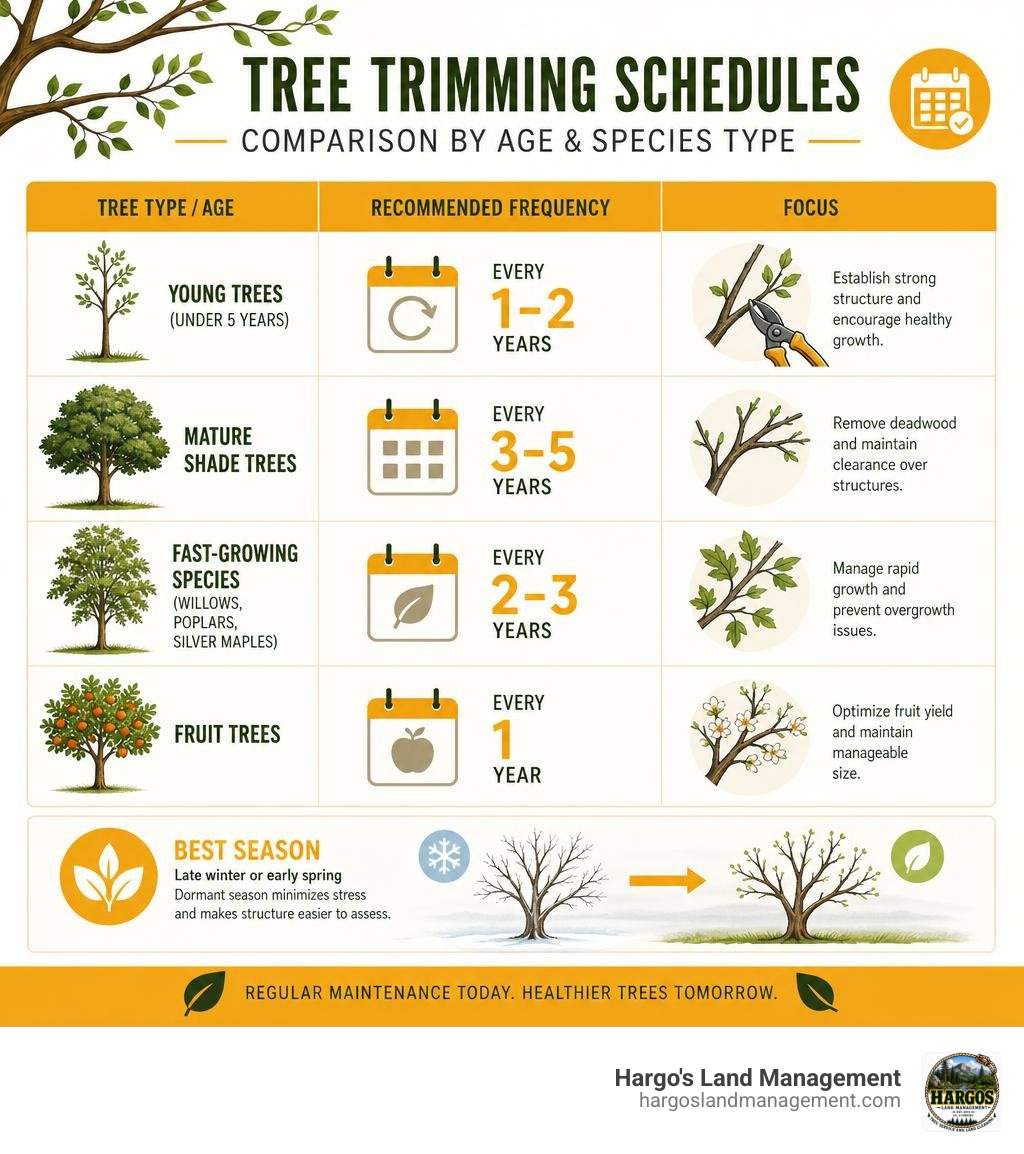
- Young Trees (Under 5 Years): Prune every 1 to 2 years to establish proper branch architecture, eliminate weak V-shaped crotches, and encourage strong leader trunks.
- Mature Shade Trees: Trim every 3 to 5 years to thin out deadwood and maintain clearance over structures.
- Fast-Growing Species: Willows, poplars, and silver maples require maintenance every 2 to 3 years.
- Fruit Trees: Require annual pruning during late winter to optimize fruit yield and maintain manageable harvesting heights.
- Best Season: Late winter or early spring (the dormant season) is the ideal time to trim most species. Leaves are absent, allowing crews to inspect branch frameworks clearly while minimizing stress and insect exposure.
Step-by-Step Guide: How to Calculate and Lower Your Tree Service Budget
Budgeting for tree maintenance does not have to be unpredictable. Follow this simple process to calculate your estimated expenses and lower overall service costs:
- Step 1: Inventory Your Property Trees: Walk your yard and note tree height tiers (small <25ft, medium 25-50ft, large >50ft), species, and proximity to houses or utility lines.
- Step 2: Check for Free Utility Line Clearance: Inspect power lines connected to utility mains. Electric providers often trim line-adjacent vegetation at no cost to property owners to prevent grid outages.
- Step 3: Bundle Multiple Trees in One Visit: Combining several trees into a single service call can save $100 or more per additional tree (typically a 10% to 20% volume discount) because equipment transportation and crew setup costs are absorbed by the initial setup.
- Step 4: Request Off-Season Scheduling: Schedule non-emergency work during late fall through late winter. Tree companies often offer discounts during slower winter months.
- Step 5: Perform DIY Cleanup: Offer to handle limb stacking, firewood splitting, or brush clearing yourself to eliminate haul-away fees ($125 to $400 savings).
- Step 6: Review Custom Services: Look into comprehensive land and landscape options to combine tree trimming with defensible space creation or property clearing.
DIY vs. Professional Care: When to Hire an ISA Certified Arborist
Attempting to trim your own trees can be tempting, but safety must dictate your decision.
Light DIY work—such as trimming low branches on small ornamental trees using pole saws, loppers, safety glasses, and thick gloves—is reasonable for most property owners. basic DIY safety gear packages run about $395 to $725 to purchase outright.
However, you should always hire a professional when:
- Branches extend within 10 feet of energized electrical wires.
- Trimming requires ladders, ropes, or climbing high into mature canopies.
- Heavy branches hang directly over homes, decks, fences, or parked vehicles.
- The tree shows structural rot, hollow trunks, or fungal decay.
Always confirm that your contractor carries active General Liability insurance (minimum $1,000,000) and Workers’ Compensation coverage. You can verify a professional’s credentials using the How Much Does Tree Maintenance Cost? [2026 Data] | Angi guide or by checking the international directory at isa-arbor.com.
Frequently Asked Questions About Tree Service Costs
How much does professional tree trimming cost on average in 2026?
The national average cost for professional tree trimming in 2026 is $460 per tree, with most projects falling between $200 and $800. Small trees (under 25 feet) cost $80 to $350, medium trees (25 to 50 feet) cost $150 to $800, and large mature trees (over 50 feet) cost $300 to $1,800 or more depending on rigging requirements. Standard hourly crew labor rates average $63 per hour. Regional adjustments vary across the country; high-cost states like California average roughly 22% higher than baseline national rates.
What key credentials should I look for when hiring a tree service?
Always request and verify three vital items before hiring a tree service contractor:
- Proof of General Liability Insurance: Protects your home and property against accidental damage during work.
- Workers’ Compensation Insurance: Covers crew members on your property so you are not held liable for work injuries.
- ISA Certified Arborist Credentials: Ensures the crew follows industry pruning standards (ANSI A300) rather than using damaging practices like tree topping.
Always get at least three itemized written estimates before selecting a provider.
Can trimming branches too heavily harm my tree?
Yes. Over-trimming can severely stress or kill a healthy tree. Never remove more than 25 percent of a tree’s living leaf canopy in a single growing season. Excessive branch removal limits the plant’s ability to produce food through photosynthesis, exposes sensitive inner bark to sunscald, invites wood-boring pests, and triggers weak, rapid water-sprout growth that breaks easily during high winds.
Conclusion
Managing tree care expenses comes down to understanding your landscape’s specific scope of work before signing a contractor quote. By calculating your baseline costs using tree height, site access, species density, and necessary add-ons like debris hauling or stump grinding, you can build a budget that keeps your property safe and visual appeal high.
At Hargo’s Land Management, we specialize in high-quality, safety-focused tree care designed for northern California properties. Whether you need crown pruning for mature oaks, defensible-space creation for fire safety, or emergency branch clearing, our local team is ready to help. Explore our complete line of Tree Service solutions, reach out directly on our Contact page, or conveniently Book Online today to schedule your free, on-site estimate!
CUSTOMER REVIEWS & TESTIMONIALS
We strive to exceed your expectations. See what our customers have to say.















CONTACT US TODAY
Serving El Dorado and Surrounding Counties
Locally owned and operated since 2013. Use our live chat support to get in touch about your land management needs today.
Request a free evaluation and estimate by completing our online form or book an on-site appointment.
El Dorado County: El Dorado Hills, Cameron Park, Shingle Springs, Coloma, Placerville, Camino, Pollock Pines, South Lake Tahoe and more...
Amador County: Jackson, Ione, and Surrounding Towns
Sacramento County: Sacramento and Surrounding Cities
Placer County: Roseville, Rocklin, Auburn, and Everything In Between
Nevada County: Penn Valley, Nevada City, Grass Valley