
Land Clearing for Construction Explained from Permits to Site Prep
Land Clearing for Construction Starts With a Build-Ready Plan
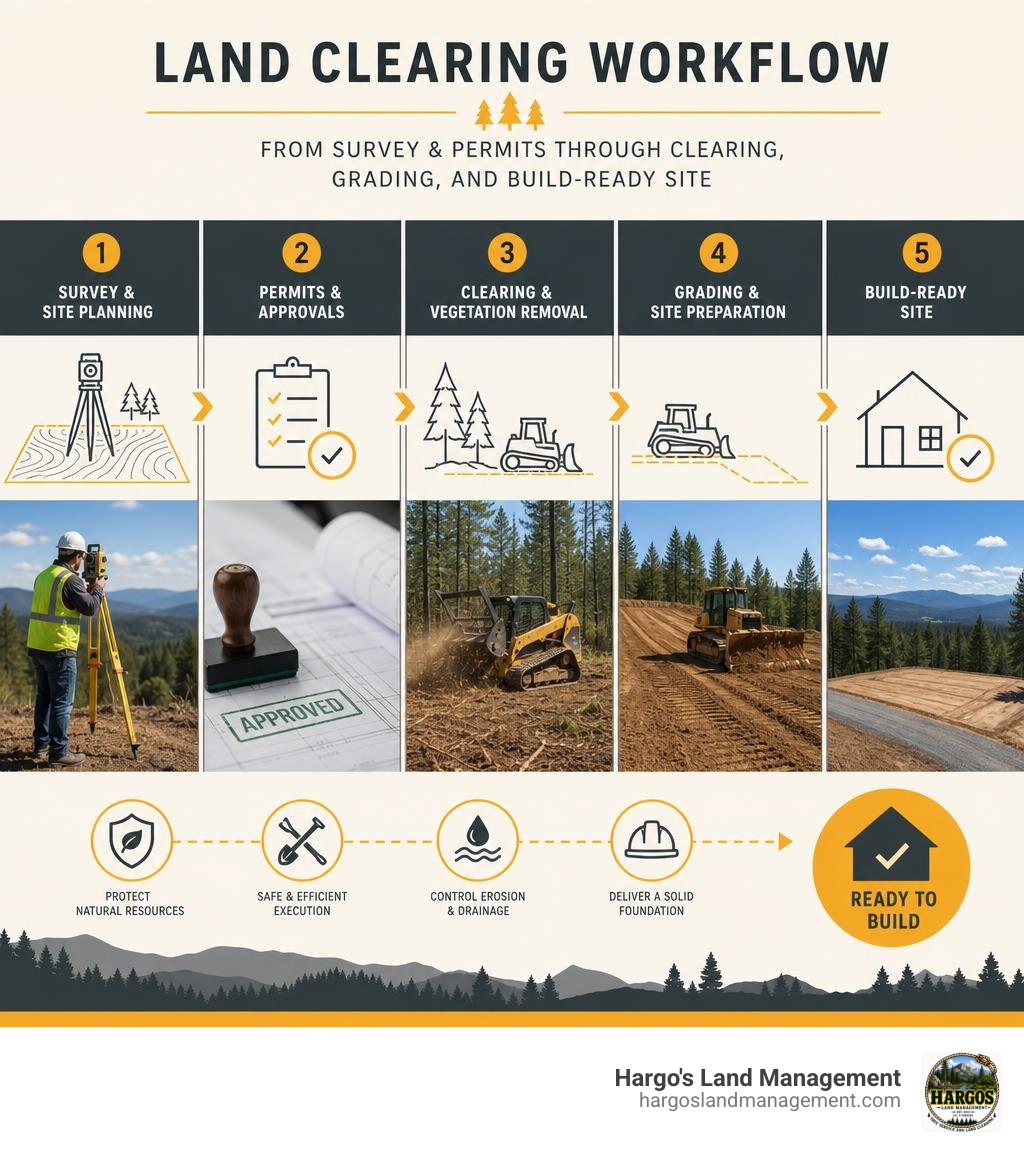
Land clearing for construction is the planned removal of trees, brush, stumps, rocks, and debris so a site can be safely graded, drained, accessed, and built on. Before equipment arrives, confirm property lines, mark utilities through 811, identify trees and natural areas to protect, secure required approvals, and install erosion controls. Then clear only the areas needed for the building pad, driveway, utilities, and defensible space.
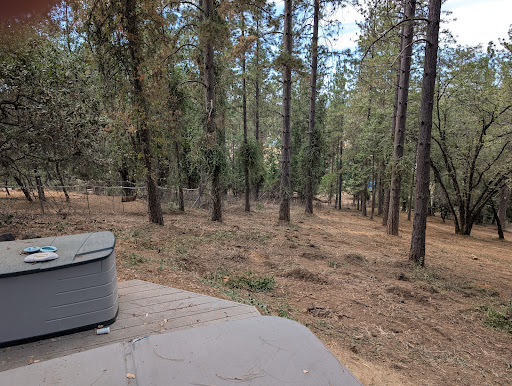
For a large El Dorado County property, the best approach is rarely to clear everything. Selective clearing and forestry mulching can reduce wildfire fuel, preserve valuable shade trees, limit soil disturbance, and leave ground cover that helps control erosion. Full clearing may be needed for foundations, roads, utility corridors, or major grading.
Clearing is not just tree work. It directly affects drainage, foundation elevations, construction access, stormwater runoff, and the cost of every phase that follows. A clear plan helps prevent damaged root zones, hidden utility strikes, permit delays, and expensive rework.
Regulatory Approvals, Permits, and Pre-Clearing Due Diligence
Stepping onto raw land is exciting, but jumping straight into heavy earthmoving without upfront planning is a recipe for budget shock. Before our operators turn an ignition key, thorough pre-clearing due diligence must take place.
A successful project begins with an accurate boundary and topographic survey. Boundary marking establishes precise property lines, preventing accidental incursions onto neighboring properties or protected easements. Topographic surveys and contour mapping allow civil engineers to accurately balance cut-and-fill calculations, ensuring that the volume of excavated earth matches what is needed for structural pads.
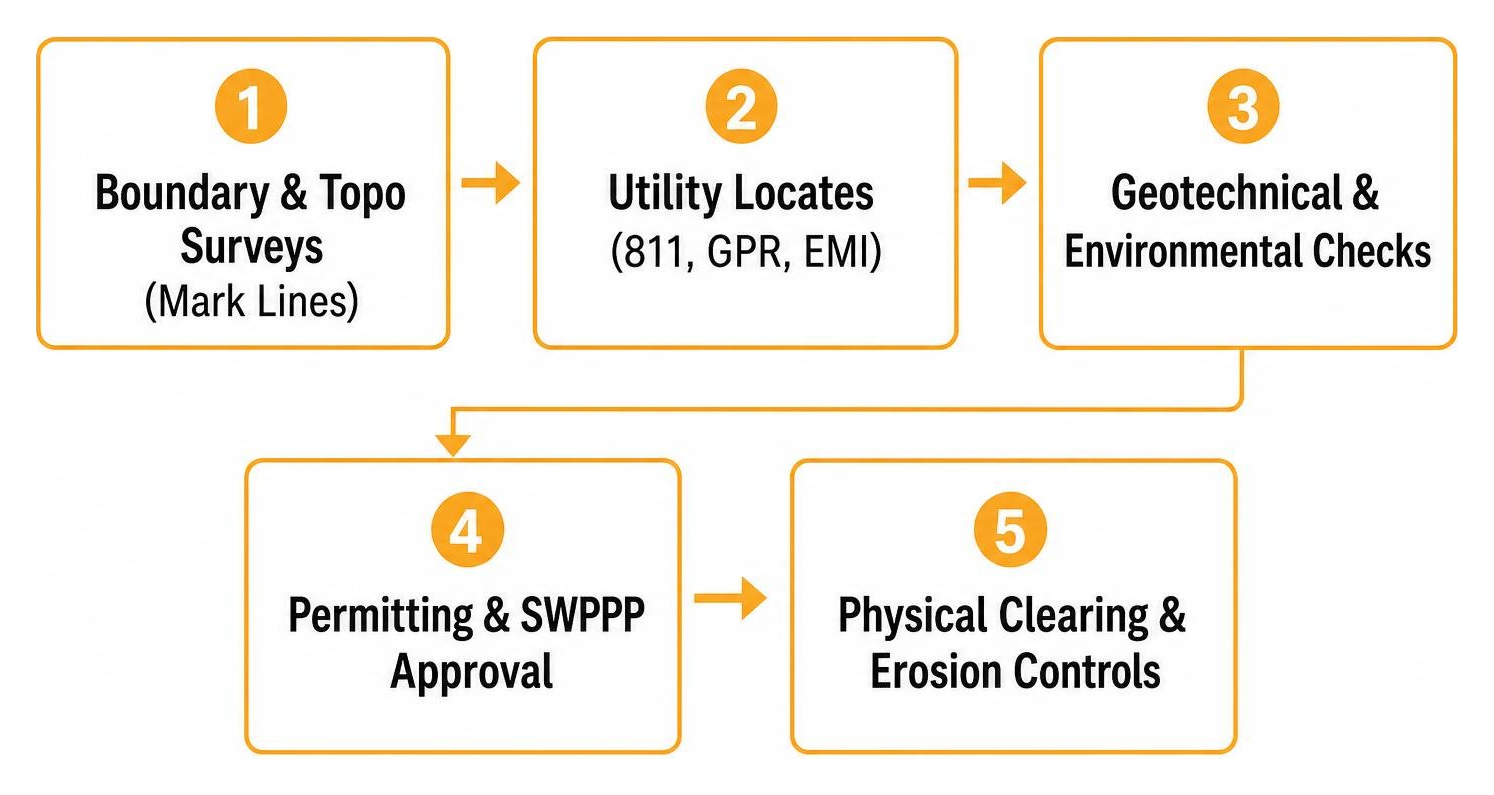
Next comes utility locating. Calling 811 marks standard public utilities, but raw acreage often hides unmapped private lines, abandoned cisterns, old well casings, or buried foundations. On complex parcels, private locating tools like ground-penetrating radar (GPR) and electromagnetic induction (EMI) prevent dangerous machine strikes.
For commercial sites and residential developments, early geotechnical soil borings verify ground load-bearing capacity and groundwater depth. Simultaneously, wetland delineation and Phase I environmental site assessments ensure protected natural features remain undisturbed.
Because hidden obstacles frequently emerge beneath thick undergrowth, experienced builders always carry a 5% to 10% site-prep contingency budget. Establishing this buffer keeps project financing intact when unanticipated subsurface rocks, wet soils, or buried debris appear.
Understanding Land Disturbance Permits and SWPPP Guidelines
Land clearing is legally distinct from routine mowing or yard cleanup. In most jurisdictions, stripping vegetation triggers formal regulatory oversight.
For instance, counties often enforce strict permit thresholds—such as requiring Land Disturbance Permits whenever clearing exceeds specific square footage (often as little as 2,500 square feet) or when cut-and-fill depths exceed 18 inches.
Under the Clean Water Act, construction projects disturbing one acre or more require coverage under a National Pollutant Discharge Elimination System (NPDES) permit and the creation of a formal Stormwater Pollution Prevention Plan (SWPPP). A complete SWPPP requires:
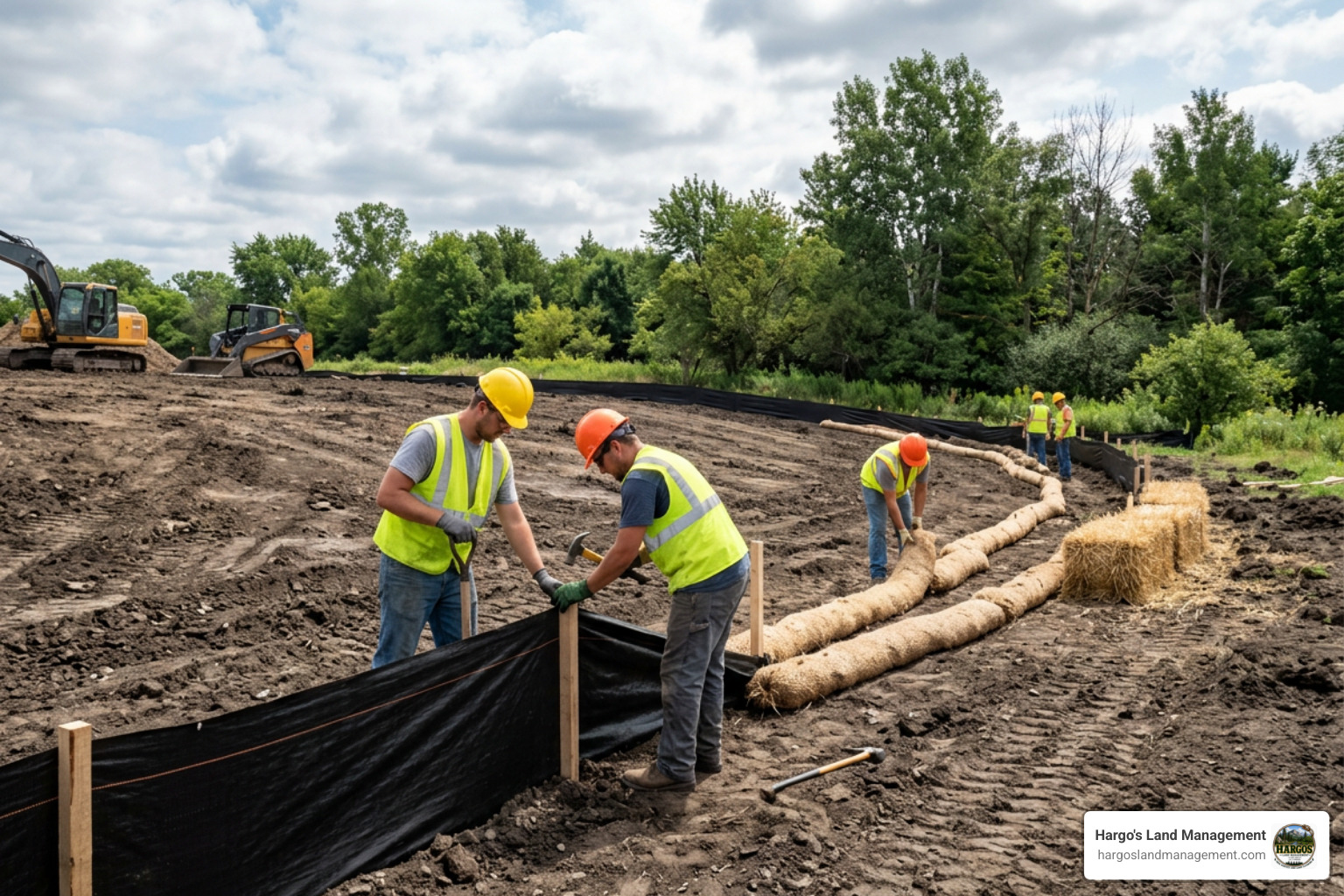
- Perimeter Silt Fences and Sediment Traps: Installed before mechanical clearing begins to trap sediment-laden water on-site.
- Sediment Basin Design: Sizing temporary retention ponds to handle peak rainfall runoffs based on the newly cleared topography.
- Phased Land Disturbance: Restricting clearing to immediate work zones rather than exposing large swaths of bare dirt simultaneously.
- Tree Protection and Replacement Plans: Formal blueprints prepared by certified arborists or landscape architects that identify preservation buffers and replanting mandates.
Failing to secure proper disturbance permits before stripping ground cover can result in immediate stop-work orders and substantial daily fines from municipal and state environmental regulators.
Utility Locates and Site Survey Protocols
Underground infrastructure demands extreme caution. Hitting an unmarked electrical feeder or pressurized gas main puts equipment operators at severe risk and instantly stalls project timelines.
We follow strict site survey and marking protocols before bringing heavy machinery on-site:
- Public and Private Locating: We verify marked 811 paint lines and utilize GPR/EMI across unrecorded rural building pads.
- Physical Boundary Ribboning: High-visibility flagging is placed along property boundaries, building envelope setbacks, and designated staging routes.
- Tree Drip Line Preservation: We establish tree protection zones (TPZs) around valuable keeper trees. Heavy machinery is strictly barred from operating within the drip line to prevent root crush and soil compaction.
- Engineering Standard Alignment: Site preparation follows established guidelines such as the ARCAT Site Clearing Specification, ensuring that all below-grade improvements within the build footprint are removed to a depth of at least 12 inches below finished grade to prevent foundation interference.
Essential Methods of Land Clearing for Construction
Every property features unique soil structures, tree densities, and slope grades. Choosing the correct mechanical clearing technique directly impacts your project timeline, overall budget, and topsoil health. When undertaking brush and land clearing, contractors select from several distinct methods based on project engineering requirements.
Cost-Effective Techniques for Land Clearing for Construction
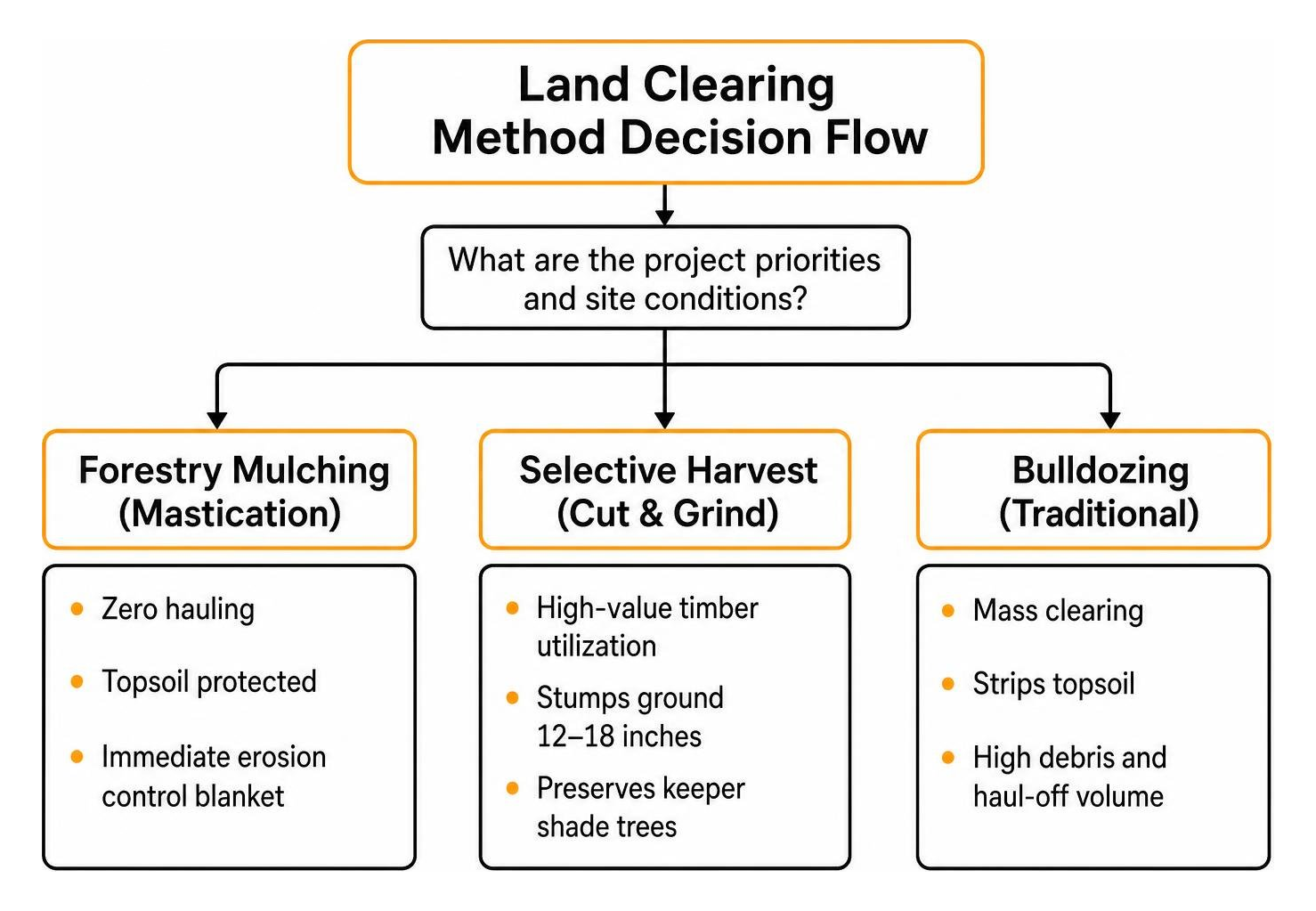
Historically, land clearing relied almost entirely on heavy bulldozers shoving trees and brush into massive piles. While pushover bulldozing is useful for large commercial developments undergoing complete mass grading, it carries major drawbacks on residential parcels. Bulldozers scrape away nutrient-rich topsoil, create huge subsurface root craters, and leave massive piles of green waste that require expensive hauling or risky open burning.
Open burning presents significant wildfire hazards—particularly across dry, fire-prone regions—and frequently violates local air quality ordinances. In 2018 alone, U.S. construction and demolition activities generated 145 million tons of debris sent to landfills, a total that modern site-prep practices actively work to reduce.
Modern mastication services and forestry mulching represent the most cost-effective and ecologically sound alternative for clearing undergrowth and small-to-medium trees (up to 8–10 inches in diameter).
A high-flow mulching head attached to a compact track loader or excavator cuts and shreds standing vegetation in place. This cut-and-grind method delivers several key advantages:
- Zero-Haul Debris Management: Vegetative waste is transformed directly into organic mulch, eliminating off-site trucking fees and tipping costs.
- Topsoil Retention: Mulchers shred vegetation at or near ground level without uprooting the underlying soil structure, keeping the topsoil intact.
- Immediate Erosion Control: The freshly distributed mulch layer forms an instant, protective blanket that absorbs rainfall impact, suppresses dust, and prevents surface runoff.
Selective Clearing vs. Full-Site Land Clearing for Construction
One of the most important decisions you will make during site planning is whether to perform selective clearing or full-site clearing.
| Feature / Metric | Selective Clearing | Full-Site Clearing |
|---|---|---|
| Primary Project Use | Custom homes, rural acreage, defensible space creation | Commercial developments, subdivisions, building pads, roadways |
| Typical Clearing Cost | $3,000–$6,000 per acre (brush/mulching) | $8,000–$30,000+ per acre (clearing, grubbing, grading) |
| Soil & Root Impact | Low; roots remain intact outside active pad footprint | High; complete root extraction and topsoil stripping |
| Erosion Risk | Minimal; mulch and existing root systems hold soil | High; requires intensive SWPPP silt fences and hydroseeding |
| Aesthetic & Asset Value | Preserves high-value mature shade trees ($5,000–$15,000 value/tree) | Clears total footprint for engineered civil pad structures |
| Wildfire Mitigation | Optimized for fire-season defensible space zones | Removes all fuel within cleared construction perimeter |
Selective clearing focuses strictly on the footprint needed for the home, driveway, utility trenches, and necessary defensible space buffers. It preserves mature hardwoods like oaks and maples, which appraise at $5,000 to $15,000 in added property value per tree.
Conversely, full-site clearing strips all vegetation across the entire lot. It is necessary within active building footprints, road alignments, and retention areas where mass grading and structural foundation engineering take priority.
Residential vs. Commercial Site Preparation Approaches
Residential and commercial projects differ significantly in scale, regulatory complexity, machinery, and execution strategy.
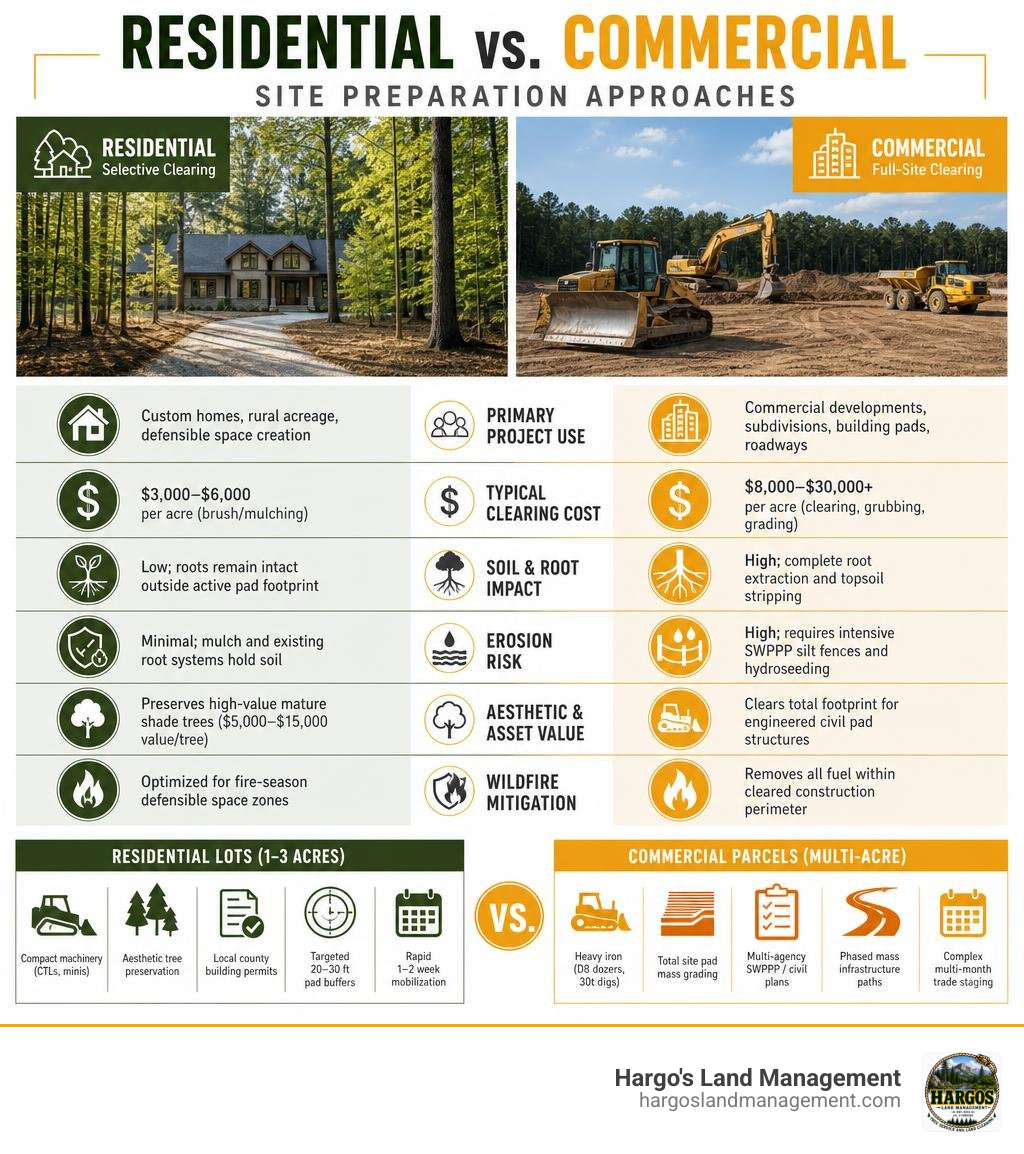
On residential parcels (typically 1 to 3 acres), the goal is balancing civil functionality with natural aesthetics. Homeowners want functional yards, driveways, and fire-safe clearance while preserving privacy and mature shade trees.
Commercial developments—such as retail centers, industrial parks, and multi-home subdivisions—require comprehensive civil grading across broad acreage. These projects necessitate extensive multi-agency environmental reviews, deep utility cutouts, and specialized vegetation management to ensure massive civil infrastructure plans proceed without regulatory delays.
Equipment Requirements and Phased Sequencing
Matching machinery to project scale prevents site damage and controls costs. Residential and light commercial jobs rely heavily on compact track loaders (CTLs), mini-excavators, and high-performance forestry mulchers that operate within tight property lines without compacting delicate root zones. Commercial civil projects deploy 30-ton excavators, heavy bulldozers, wheel loaders, and articulated dump trucks.

Regardless of scale, disciplined contractors follow a clear phased sequence:
- Access Corridor Clearing First: We clear and stabilize the permanent driveway or construction entrance first. A basic 12-foot-wide gravel driveway ($12–$25 per linear foot) gives concrete mixers, logging trucks, and material haulers a stable path, preventing heavy equipment from churning up wet subsoils across the site.
- Infrastructure Corridors Second: Clearing the paths for power lines, sewer hookups, water lines, and stormwater culverts allows utility contractors early access.
- Targeted Building Envelopes Third: We clear the structural building pad plus a 20-to-30-foot perimeter buffer. This buffer provides the necessary clearance for foundation excavation, scaffolding, and structural framing while preserving trees outside the active work zone.
Debris Management, Stump Removal, and Topsoil Preservation
What happens underground is just as critical as what happens above. Leaving tree stumps inside a planned building envelope is a major structural mistake. As buried stumps decay over several years, they leave behind subterranean voids that cause foundation settling, cracked slabs, and driveway failure.
Inside structural footprints and driveway paths, stumps must be mechanically extracted or ground down 12 to 18 inches below grade. Outside building footprints—such as in open yards or natural buffers—stump grinding to ground level is often sufficient, saving substantial excavation expenses. Stump removal generally adds $3 to $8 per inch of stump diameter, or $100 to $300 per stump.
Before mass excavation, contractors strip topsoil and stockpile it in designated, silt-fenced areas. This preserves nutrient-rich soil free from construction debris, allowing it to be redistributed across the property during final landscaping.
Integrating Drainage, Grading, and Civil Infrastructure
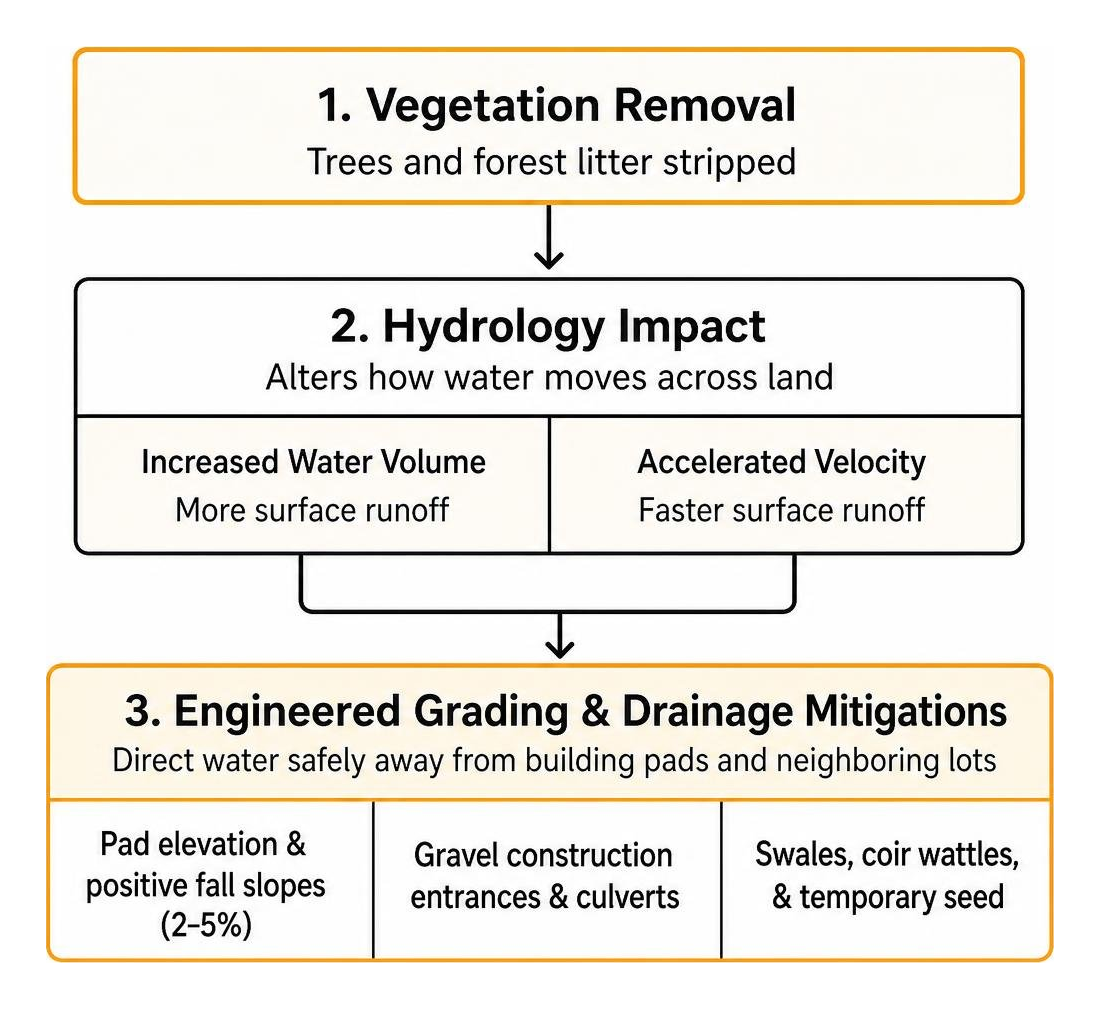
Removing mature vegetation completely alters how water moves across land. Trees and forest litter naturally absorb immense quantities of rainwater; stripping them bare increases both the velocity and volume of surface runoff.
Without calculated water redirection, post-clearing storms can quickly wash out building pads, scour driveway sub-bases, and flood neighboring lots. Coordinating clearing with our comprehensive site preparation services guarantees that grading, drainage, and utility work align seamlessly with civil blueprints.
Grading and Building Pad Preparation
Grading reshapes raw ground to establish a stable, level building pad that channels water safely away from future foundations.
- Pad Elevation and Soil Compaction: Operators balance cut-and-fill zones, compacting sub-base soils in controlled lifts to achieve required engineering load-bearing standards (preventing post-construction structural settling).
- Positive Drainage Slopes: Pad perimeters are graded with a continuous 2% to 5% downward slope away from foundation walls to guide surface water into engineered swales or detention basins.
- Utility Trench Corridors: Trenches for water, sewer, power, and gas are excavated, bedded with aggregate, and backfilled without compromising structural pad density.
Erosion Control and Stormwater Management
Erosion control measures must be maintained continuously from the moment the first tree is cleared until final landscaping is established.
To maintain environmental compliance and safeguard newly graded soils, we implement several field-tested controls:
- Coir and Straw Wattles: Installed along slope contours to slow sheet runoff and trap sediment particles before water reaches perimeter boundaries.
- Vegetated Swales and Culverts: Broad, shallow channels shaped to collect surface runoff from driveways and roofs, directing water into municipal storm drains or retention basins.
- Temporary Hydroseeding: Applying fast-germinating grass seed and tackified straw over exposed dirt stockpiles and slopes prevents wind and rain erosion during multi-month builds.
Frequently Asked Questions About Construction Site Prep
How much does it typically cost to clear land for building?
Land clearing costs vary based on acreage, tree density, slope steepness, and project scope.
For a typical 1-to-3-acre residential lot, full site prep—including selective clearing, stump removal, building pad grading, and a basic gravel construction driveway—typically ranges from $14,000 to $53,000+.
Basic brush clearing and forestry mulching generally cost between $3,000 and $6,000 per acre, while dense timber clearing requiring complete stump extraction, hauling, and rough grading runs from $8,000 to $30,000+ per acre.
Budgeting a 5% to 10% contingency helps absorb unforeseen ground conditions like subsurface boulders or high water tables.
What is the difference between land clearing and tree removal?
Tree removal focuses strictly on taking down individual trees that present safety hazards, show disease, or block a specific view.
Land clearing is a comprehensive civil site-preparation process. It involves removing vegetation, underbrush, roots, and surface rocks across an engineered footprint. It prepares raw acreage for building pads, access roads, utility trenches, and civil drainage systems in accordance with approved architectural and engineering site plans.
How do developers prevent delays and unexpected costs during lot clearing?
Developers prevent delays by investing in thorough pre-bid due diligence. This includes commissioning accurate topographic boundary surveys, conducting utility locates with GPR/EMI, performing geotechnical soil borings, and delineating wetland buffers before drafting final plans.
Additionally, establishing clear contractor bid specifications (such as explicit grubbing depths and debris handling requirements), clearing in coordinated phases, and maintaining a strict written change-order protocol keeps site work on schedule and within budget.
Preparing Your Site for a Safe, Lasting Build
Transforming raw land into a build-ready site is a multi-step engineering process. Every phase—from boundary surveys and permit approvals to selective forestry mulching, stump extraction, and final pad grading—directly impacts the safety, drainage, and cost of your construction project.
At Hargo’s Land Management, we provide residential and commercial land clearing, vegetation management, and fire-season defensible-space creation throughout El Dorado County, including Placerville and South Lake Tahoe. As a locally owned, licensed, bonded, and insured contractor, we deliver fast, high-quality, fire-safety-focused site prep tailored to regional terrain.
If your project requires clearing dense brush, establishing defensible space buffers, or safely removing high-risk trees within your building envelope, our team is equipped to prepare your land for construction. Contact us today to schedule your free on-site estimate, explore our hazardous tree removal solutions, or Book Online to get your build site underway.
CUSTOMER REVIEWS & TESTIMONIALS
We strive to exceed your expectations. See what our customers have to say.















CONTACT US TODAY
Serving El Dorado and Surrounding Counties
Locally owned and operated since 2013. Use our live chat support to get in touch about your land management needs today.
Request a free evaluation and estimate by completing our online form or book an on-site appointment.
El Dorado County: El Dorado Hills, Cameron Park, Shingle Springs, Coloma, Placerville, Camino, Pollock Pines, South Lake Tahoe and more...
Amador County: Jackson, Ione, and Surrounding Towns
Sacramento County: Sacramento and Surrounding Cities
Placer County: Roseville, Rocklin, Auburn, and Everything In Between
Nevada County: Penn Valley, Nevada City, Grass Valley