Protect Your Home with a Certified Arborist Tree Risk Assessment
Understanding Arborist Tree Risk Assessment and Its Importance
Tree risk assessment is a systematic process used to identify, analyze, and evaluate the safety risks posed by trees in urban and suburban landscapes. Unlike a basic visual inspection, a formal arborist tree risk assessment evaluates three specific variables: the likelihood of a tree or branch failing, the likelihood of that failing part striking a specific target, and the severity of the potential consequences.
Tree risk assessment is essential because trees in residential settings grow in close proximity to homes, driveways, power lines, and pedestrian walkways. Left unmanaged, structural defects can result in catastrophic failure during heavy weather or high winds. However, removing every tree with a minor flaw is neither practical nor ecologically responsible. Standardized risk rating systems quantify risk objectively, allowing us to implement proactive maintenance rather than relying on guesswork. By taking a structured approach, we balance public safety with urban canopy retention, ensuring property owners satisfy their legal duty of care while preserving valuable trees. For a deeper look at urban canopy management principles, review Managing urban forest risk and failure potential.
Hazard Trees vs Manageable Tree Risk
In modern arboriculture, we carefully distinguish between a “hazard tree” and a tree with “manageable risk.” Labeling a tree as a hazard relies purely on defect identification—such as finding a hollow trunk or a cracked branch—which often triggers an immediate, panic-driven decision to fell the tree.
In contrast, an arborist tree risk assessment considers the overall setting. A severely decayed tree located deep in a dense forest with no nearby structures or human traffic presents structural failure potential, but zero risk because there is no target to hit. Conversely, a minor defect in a branch directly over a bedroom demands attention. Manageable risk means identifying structural defects early and applying corrective options—such as crown thinning, end-weight reduction, structural support systems, or moving the target below (like relocating a picnic table)—to reduce the probability of damage without cutting down the tree.
Evaluating Likelihood of Failure, Impact, and Consequences
To maintain objectivity, credentialed assessors rely on standardized rating matrices. Factors are typically evaluated on 4-point qualitative scales:
- Likelihood of Failure: Categorized as Imminent, Probable, Possible, or Improbable based on structural integrity, decay presence, and load forces.
- Likelihood of Impact: Evaluated as High, Medium, Low, or Unlikely, taking into account target occupancy rates (e.g., a static house versus a driveway used twice a day).
- Consequences of Failure: Rated as Severe, Significant, Minor, or Negligible based on the size of the failing part and target value.
Combining the likelihood of failure and impact yields a categorized matrix score ranging from Low to Extreme. To eliminate subjectivity in visual evaluations, cutting-edge research explores advanced computational modeling. Property managers interested in standardizing visual protocols can examine Research on dynamic AI models for risk assessment.
The Three Levels of Tree Risk Assessment Explained
Under industry standards established by the International Society of Arboriculture (ISA) and the American National Standards Institute (ANSI A300 standards), professional evaluations are categorized into three distinct levels of assessment.
| Assessment Level | Primary Method | Common Use Cases | Standard Tools |
|---|---|---|---|
| Level 1: Limited Visual | Rapid visual scan from a specified perspective (walk-by, drive-by, aerial aerial scan) | Municipal street corridors, large commercial campuses, post-storm triage | Binoculars, GIS mapping, vehicle-based inspection |
| Level 2: Basic | 360-degree ground-level inspection of trunk, roots, and crown | Residential shade trees, trees near homes or structures | Mallet sounding, soil probe, measuring tape, binoculars |
| Level 3: Advanced | In-depth diagnostic testing and internal wood evaluation | High-value historic trees, severe decay evaluation, legal disputes | Sonic tomography, micro-resistance drilling, aerial climbing |
Level 1: Limited Visual Arborist Tree Risk Assessment
Level 1 assessments are rapid visual screenings designed to evaluate large populations of trees efficiently. Often conducted as a drive-by windscreen survey or walk-by evaluation along utility corridors, this level focuses on identifying obvious structural hazards, such as major dead wood, severe leaning, or large uprooted root plates visible from a single vantage point. Level 1 assessments are budget-friendly tools for broad spatial planning, though subtle or hidden internal defects may be missed due to the restricted perspective.
Level 2: Basic Ground Inspection Protocols
Level 2 basic assessment represents the standard comprehensive evaluation for residential and commercial trees. A credentialed arborist conducts a 360-degree ground-level walk around the individual tree, inspecting the root flare, main stem, branch attachments, and canopy.
During a Level 2 assessment, the assessor uses basic manual tools:
- Sounding Mallets: Striking the trunk to listen for hollow acoustic feedback indicative of internal decay cavities.
- Soil Probes: Testing for root plate instability, uncompacted fill, or hidden decay at the root collar.
- Binoculars: Scanning the upper canopy for included bark, broken hangers, and structural cracks.
Level 3: Advanced Arborist Tree Risk Assessment Diagnostics
When a Level 2 basic ground inspection uncovers significant decay, structural anomalies, or internal hollows in a prominent tree, a Level 3 advanced assessment is recommended. Rather than removing a valuable specimen based on assumptions, Level 3 evaluations deploy non-invasive diagnostic tools to measure remaining load-bearing capacity.
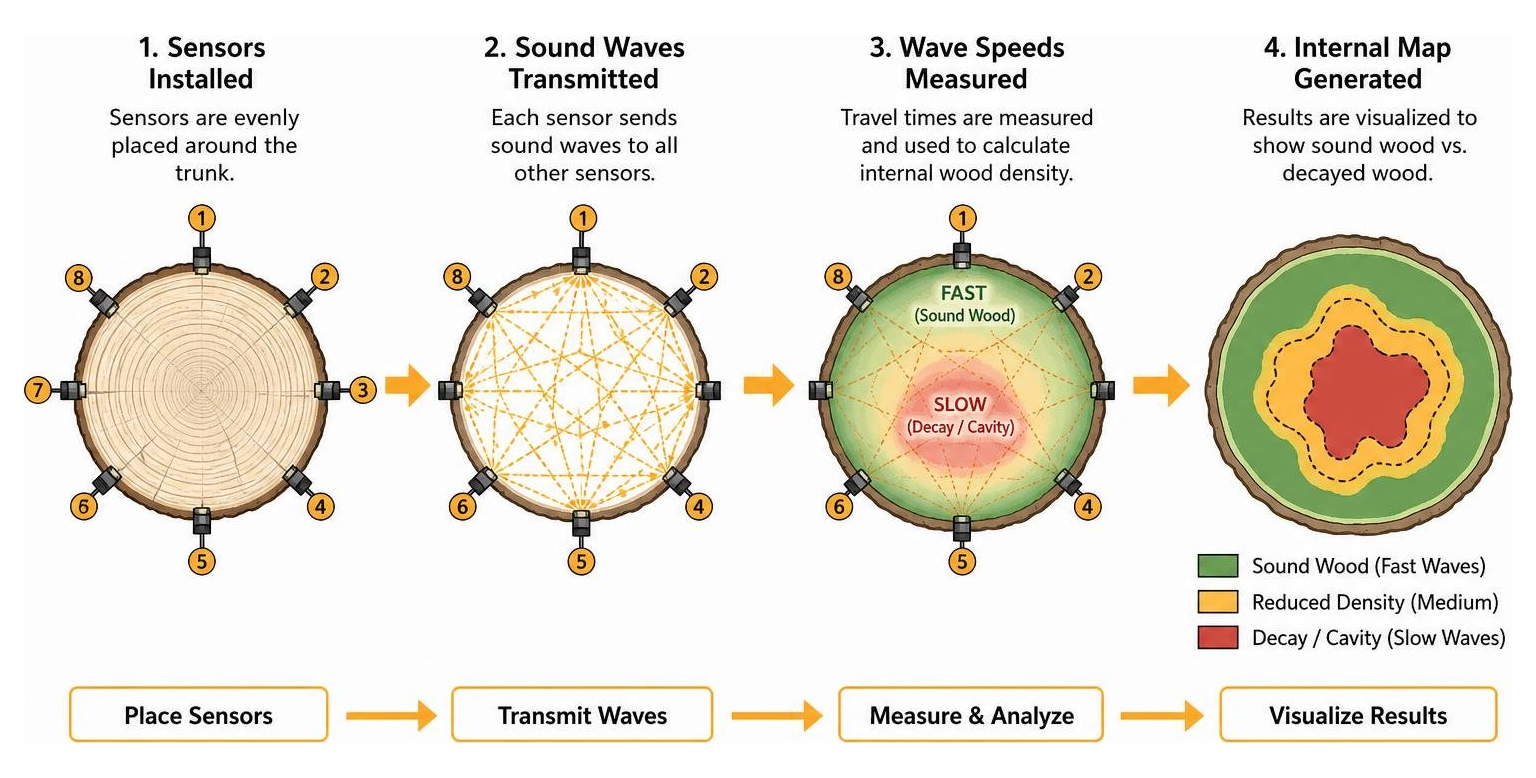
These diagnostic techniques include:
- Sonic Tomography: Transmitting acoustic sound waves across multiple sensors around the trunk to map internal sound wood, decay, and cavities.
- Micro-Resistance Drilling: Inserting a microscopic drill bit into the wood to record resistance profiles, measuring sound shell thickness precise to the millimeter.
- Aerial Climbing Inspections: Sending a climbing arborist into the upper canopy to perform close-up structural checks of upper branch unions.
To see how Level 3 diagnostic testing protects heritage trees from unnecessary felling, review this Advanced diagnostic report on mature heritage oak.
Key Visible Defect Indicators and Professional Evaluation
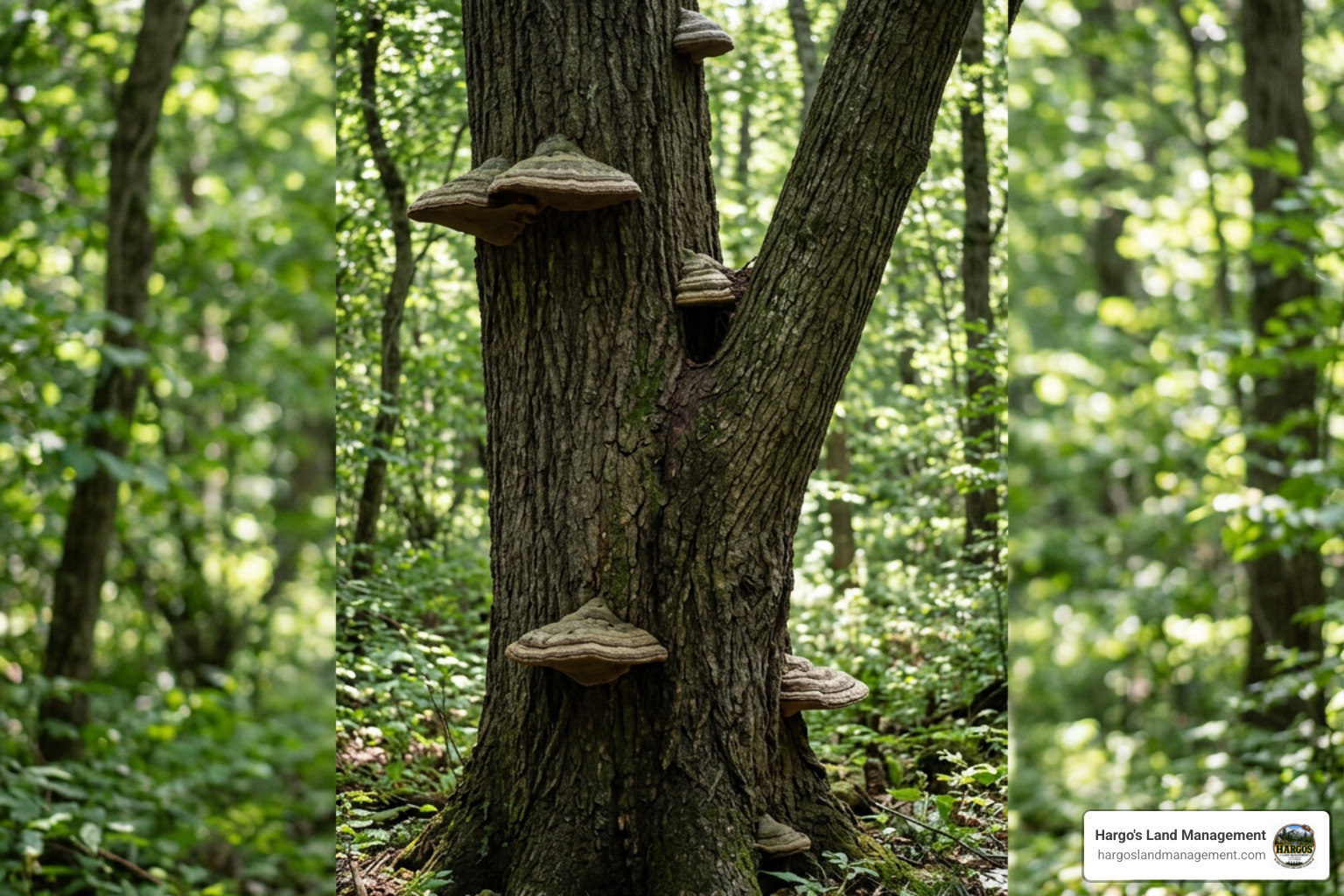
Property owners can spot early warning signs by understanding common visual defect indicators. While identifying these red flags is helpful, interpreting their structural impact requires professional evaluation.
Warning Signs in Trunk and Canopy
- Fungal Fruiting Bodies (Conks): Bracket fungi or mushrooms growing out of the trunk or root flare are clear indicators of active internal wood decay.
- Codominant Stems and V-Shaped Crotches: When two main stems grow to equal size from a sharp V-shaped angle, trapped bark (“included bark”) prevents structural wood bonding. As the stems grow larger, wind forces act as a lever, making V-shaped unions prone to sudden splitting compared to strong U-shaped attachments.
- Trunk Cavities and Longitudinal Cracks: Deep open cavities, vertical frost cracks, or opposing seams signal compromised internal load-bearing capacity.
- Sudden Leans and Dead Branch Drops: A tree that leans suddenly following a storm—especially with fresh soil cracking at its base—presents immediate danger. Similarly, unprompted drop of large green branches indicates structural stress.
Root System and Soil Defect Signs
Root integrity dictates overall tree stability. Key indicators of root-zone decay or damage include:
- Girdling Roots: Roots that wrap tightly around the base of the trunk, choking off nutrient transport and causing localized decay.
- Buried Root Flare: Soil or thick mulch piled against the trunk wood traps moisture, promoting root-collar rot. A healthy tree should display a clear, visible flare expanding outward at ground level.
- Soil Heaving and Root Plate Decay: Soil lifting or cracking on the side opposite a lean indicates root severance, failure, or rot beneath the ground.
- Excavation Damage: Recent trenching or construction within the root zone severely compromises structural anchorage.
Mitigating Risk Without Unnecessary Tree Removal
Fear of liability often leads property owners to remove trees unnecessarily—a phenomenon known in the industry as “Grim Reaper syndrome,” where aggressive management slates structurally manageable trees for total removal. Modern urban forestry emphasizes tree retention wherever safe. Trees provide immense ecological, aesthetic, and property-value benefits. Professional risk evaluation aims to reduce risks to acceptable levels without defaulting to whole-tree removal. For complete standards governing risk mitigation, consult the ISA Tree Risk Assessment manual standards.
Non-Removal Risk Mitigation Options
Except in extreme cases where structural failure is imminent and targets cannot be protected, arborists recommend targeted mitigation strategies:
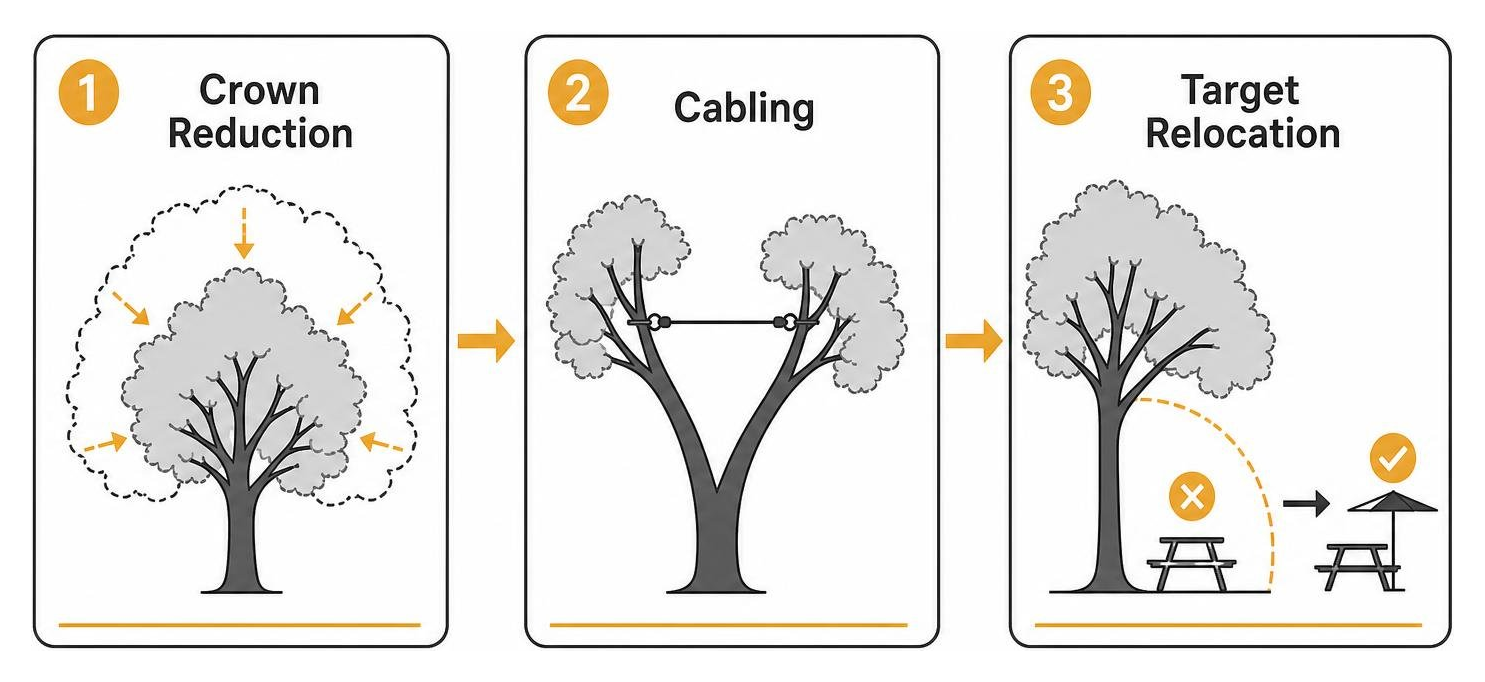
- Crown Reduction Pruning: Reducing canopy height and spread to decrease wind resistance (sail area) and lower mechanical stress on vulnerable unions.
- End-Weight Reduction: Pruning heavy outer branch ends to shorten the lever arm acting on codominant stems or decay points.
- Supplemental Cabling and Static Bracing: Installing high-tensile steel flexible cables or rigid steel threaded rods in upper unions to restrict movement during high winds.
- Target Relocation: Moving vulnerable items (such as outdoor furniture, playground sets, or parked vehicles) out of the drop zone beneath a structurally weak tree.
The Role of TRAQ Credentialing and Artificial Intelligence
Not all arborists hold equal risk assessment qualifications. The International Society of Arboriculture developed the Tree Risk Assessment Qualification (TRAQ) to establish standardized, legally defensible evaluation protocols. TRAQ credential holders complete rigorous field and written assessments and must retrain and retest every seven years to maintain their status.
Additionally, emerging “White AI” technology—transparent, rule-based computational models relying on fuzzy set theory—helps arborists process visual variables like wind load exposure and lever arm dimensions objectively. These tools minimize subjective bias and back up human arborist evaluations with auditable data.
Documentation, Regular Inspection, and Fire Safety Defensible Space
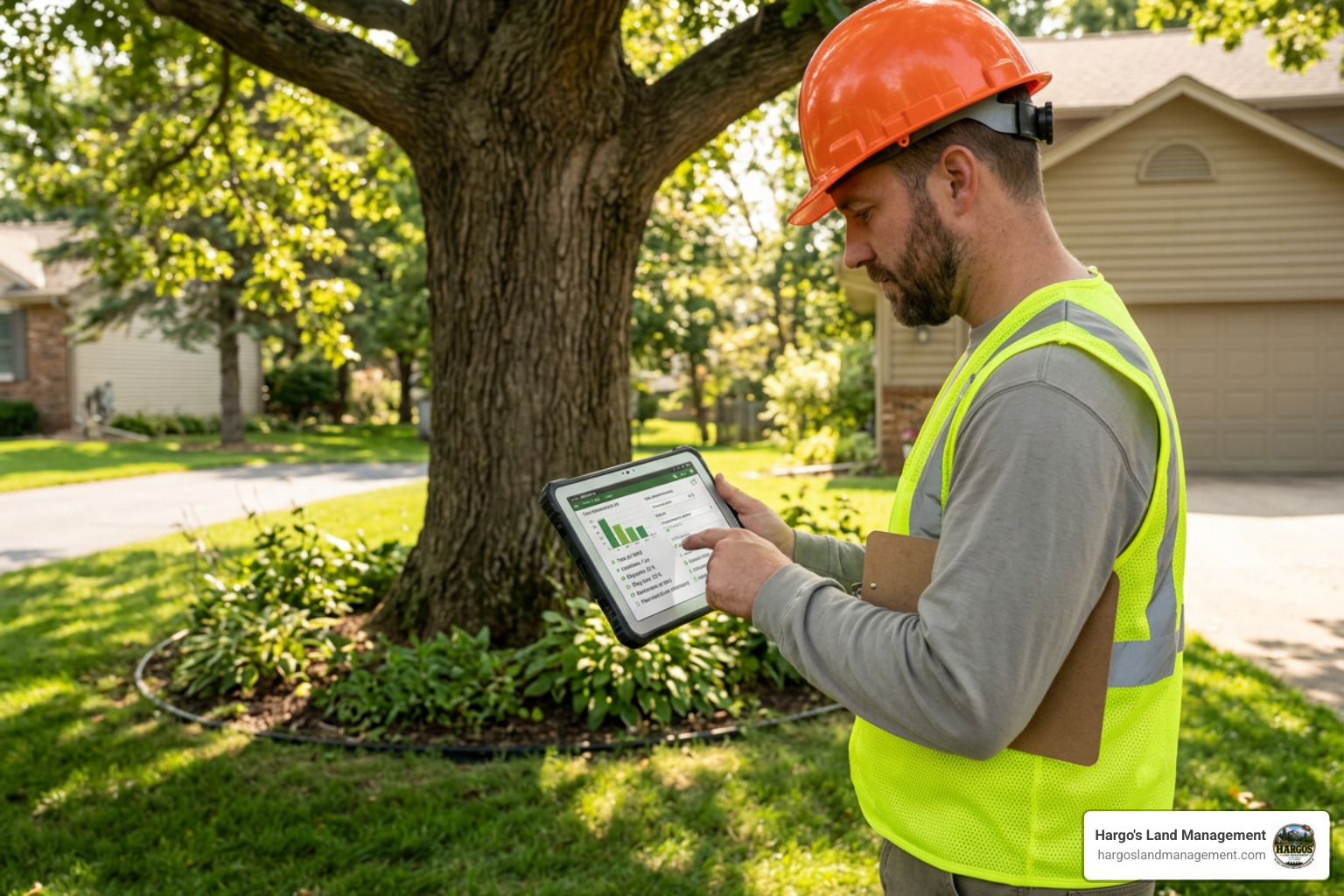
Maintaining a written assessment report provides property owners with vital documentation. Inspections should generally occur every 2 to 3 years, or immediately following severe weather events. Detailed reports establish a clear history of proactive care, satisfying legal duty-of-care obligations and aiding in insurance verification if storm damage occurs.
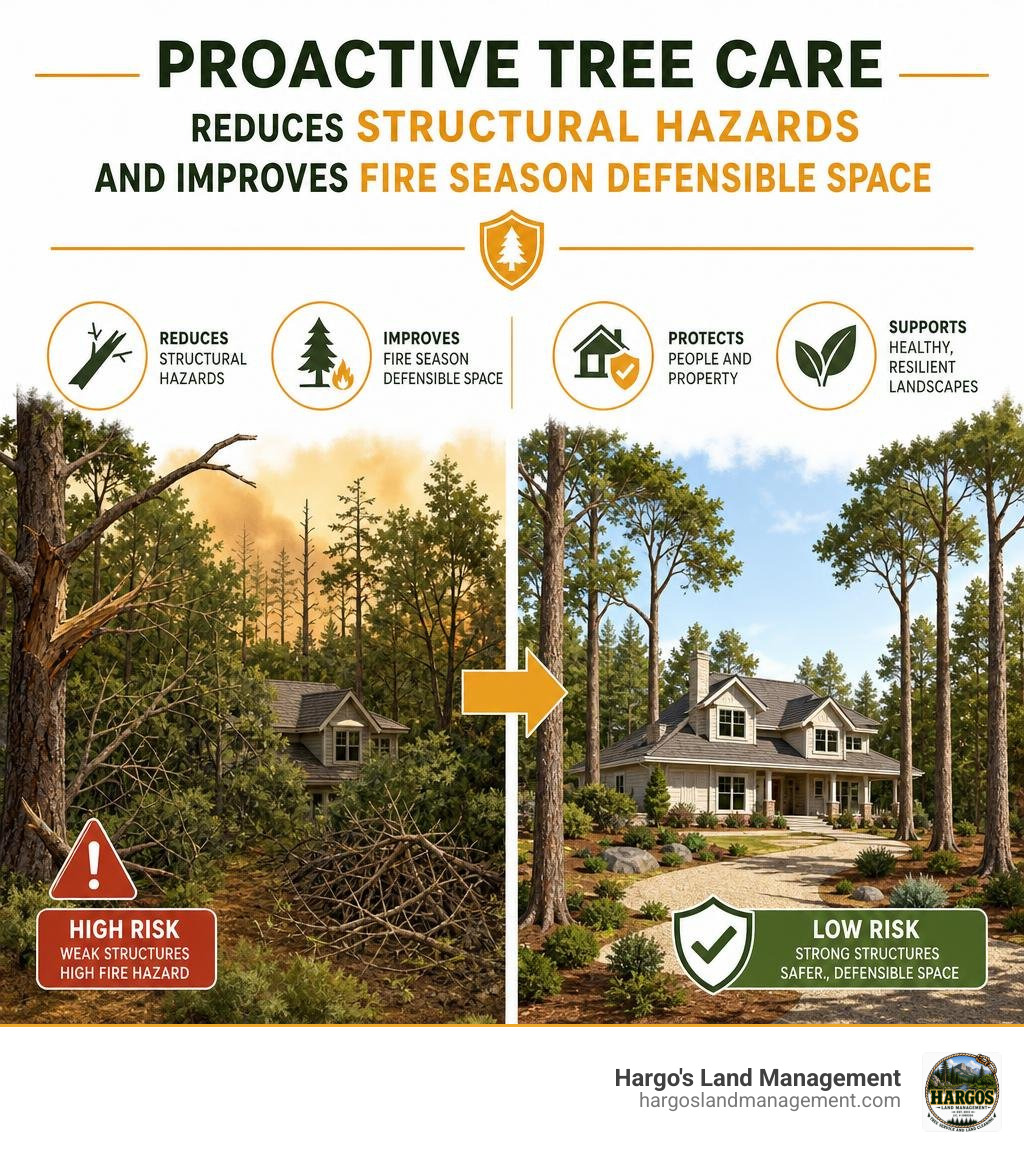
In regions like El Dorado County, tree risk assessments serve a dual purpose: evaluating structural stability while optimizing fire-season defensible space. Dense brush, dead canopy wood, low-hanging ladder fuels, and overgrown branches overhanging rooflines pose severe wildfire hazards. Integrated land management combines risk evaluations with fire-safety clearing, crown raising, brush removal, and defensible-space creation to protect structures from fire and fall hazards alike.
Frequently Asked Questions About Tree Risk Assessment
How often should property owners schedule a professional tree risk assessment?
We recommend scheduling a formal arborist tree risk assessment every 2 to 3 years for mature trees located near homes, driveways, or high-use areas. Additionally, trees should be visually checked after severe weather events like heavy snow, ice, or high winds.
What is the difference between an ISA Certified Arborist and a TRAQ qualified arborist?
An ISA Certified Arborist has demonstrated general knowledge in tree care, biology, pruning, and soil management. A TRAQ (Tree Risk Assessment Qualified) arborist is an ISA Certified Arborist who has undergone specialized training and testing exclusively in standard methodologies for evaluating structural defects, calculating failure probabilities, and generating legally defensible risk reports.
Can a tree categorized as high risk be saved without total removal?
Yes. High risk ratings indicate a combination of failure likelihood and target exposure, but total removal is an act of last resort. Arborists can frequently reduce risk ratings to low or moderate by implementing structural crown reduction pruning, installing supplemental cabling systems, or removing specific defective limbs while keeping the main tree standing safely.
Conclusion
Proactive tree management protects your home while preserving the shade, beauty, and ecological benefits of mature trees. Relying on accurate risk quantification helps property owners avoid impulsive tree removal driven by fear, focusing resources where structural defects genuinely threaten safety.
At Hargo’s Land Management, our locally owned team provides licensed, bonded, and insured tree care across El Dorado County, including Placerville and South Lake Tahoe. Whether you need rapid fire-safety clearing, structural pruning, or complete tree management, we offer free on-site estimates tailored to your property. To secure your property against storm damage and wildfire hazards, Schedule Professional Hazardous Tree Removal Services with our expert team today.
CUSTOMER REVIEWS & TESTIMONIALS
We strive to exceed your expectations. See what our customers have to say.















CONTACT US TODAY
Serving El Dorado and Surrounding Counties
Locally owned and operated since 2013. Use our live chat support to get in touch about your land management needs today.
Request a free evaluation and estimate by completing our online form or book an on-site appointment.
El Dorado County: El Dorado Hills, Cameron Park, Shingle Springs, Coloma, Placerville, Camino, Pollock Pines, South Lake Tahoe and more...
Amador County: Jackson, Ione, and Surrounding Towns
Sacramento County: Sacramento and Surrounding Cities
Placer County: Roseville, Rocklin, Auburn, and Everything In Between
Nevada County: Penn Valley, Nevada City, Grass Valley