Safe High Risk Tree Removal Solutions for Hazardous Trees Near You
Why High Risk Tree Removal Cannot Wait
High risk tree removal is the safest choice when a tree shows signs it could fail and strike a home, driveway, vehicle, power line, or area where people spend time. A tree does not have to be dead to be dangerous. A living tree with a new lean, lifting soil around its roots, deep trunk cracks, decay fungi, or large hanging limbs may need urgent professional assessment.
For El Dorado County property owners, the concern is often bigger than one tree. Hazardous trees, overgrown brush, and weak limbs can add to wildfire exposure and put access roads, structures, and defensible space at risk.
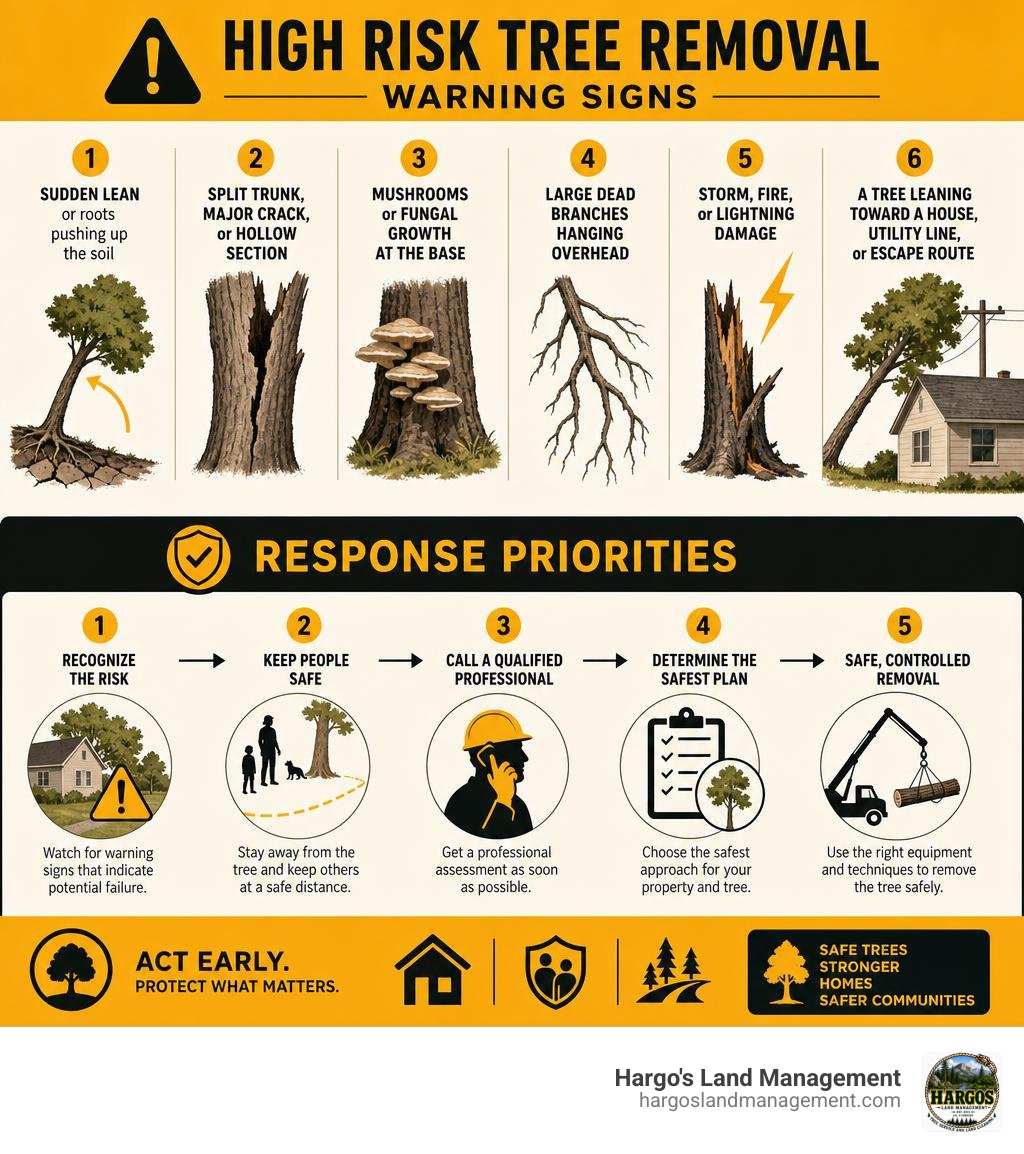
Call a qualified tree service promptly when you notice:
- A sudden lean or roots pushing up the soil
- A split trunk, major crack, or hollow section
- Mushrooms or fungal growth at the base
- Large dead branches hanging overhead
- Storm, fire, or lightning damage
- A tree leaning toward a house, utility line, or escape route
A trained crew can determine whether the tree can be managed or needs controlled removal. For unstable trees near structures, this often means taking it down in small sections with rigging or crane support rather than trying to fell it in one piece.
What Defines a High Risk Tree Removal?
Not every dead or ugly tree poses an immediate threat to life and property. Standard tree removal deals with trees that are simply unwanted, crowding out sunlight, or already dead in an open field where dropping them causes zero collateral damage.
In contrast, high risk tree removal involves a tree with significant structural failure mechanisms situated directly within striking distance of a “target”—such as your roof, garage, power line, or backyard patio.
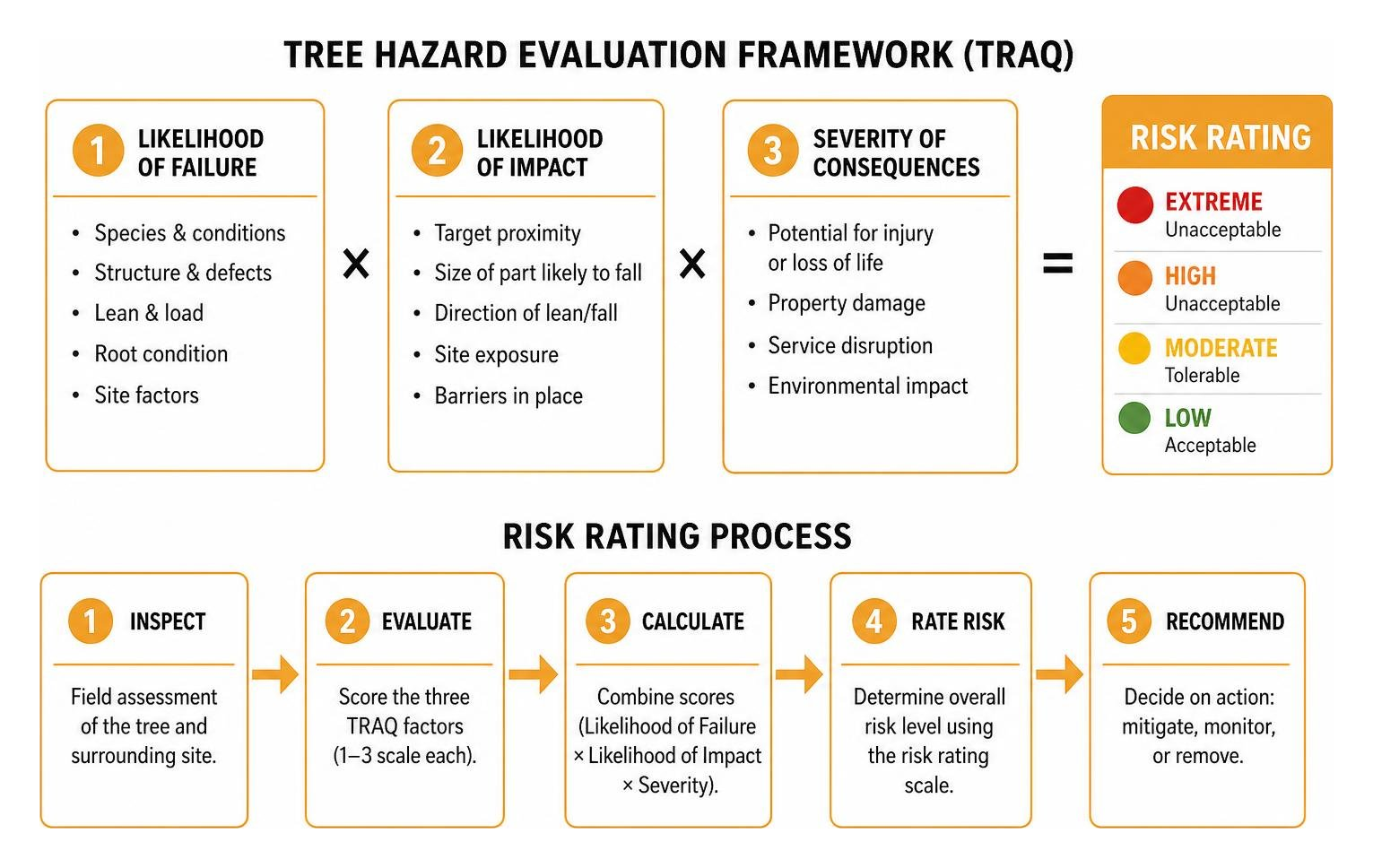
To systematically evaluate these threats, professional arborists rely on the Tree Risk Assessment Qualification (TRAQ) framework established by the International Society of Arboriculture (ISA). Under TRAQ standards, risk is measured by combining the likelihood of tree failure, the likelihood of impacting a target, and the severity of potential consequences.
A tree qualifies as high risk when internal decay, severe structural lean, or extensive root damage weakens its load-bearing capacity to a point where normal wind, snow loads, or even gravity could trigger a sudden collapse.
Key Warning Signs of Immediate Tree Danger
Trees usually give clear warning signals long before they fall. Recognizing these red flags early can prevent catastrophic property damage:
- Mushroom Conks and Fungal Growth: Fungi or conks sprouting at the root collar or along the trunk indicate active internal decay. Mushrooms are the fruiting bodies of fungi that feed on heartwood, hollowing out the tree from the inside out.
- Hollow Trunks and Cavities: While some hollow trees remain structurally sound if they retain sufficient shell thickness, a thin outer wall of sound wood combined with heavy canopy weight makes failure imminent. Arborists sound the trunk with mallets or use resistograph drills to measure remaining wood density.
- Vertical Trunk Cracks: Deep, longitudinal splits running down the trunk signal that structural wood fibers have separated under severe shear stress.
- Codominant Stems with Included Bark: When a tree grows two main trunks of similar size, bark often gets trapped inside the V-shaped union. This “included bark” prevents the stems from bonding securely, turning the union into a primary failure point during high winds.
- Widowmakers: Large, unattached dead branches suspended high in the canopy earned their ominous nickname for a reason. These heavy limbs can drop without warning on calm, sunny afternoons.
- Root Rot and Soil Heaving: If you notice freshly exposed soil, cracked turf, or heaved roots on the side opposite a tree’s lean, the root plate is actively pulling out of the ground.
Species Prone to Failure in High Risk Tree Removal
While any species can become hazardous under harsh conditions, certain trees possess inherent structural weaknesses or shortened lifespans that make them frequent candidates for technical extraction. Regional arborists frequently handle species-specific risks documented across industry literature, such as resources provided by the International Society of Arboriculture.
- Bradford Pear: Infamous for fast growth and extremely weak V-shaped branch unions, Bradford pears typically reach a structural failure age between 15 and 25 years. They regularly split under moderate wind or ice storms.
- Laurel Oak: Laurel oaks feature a relatively short lifespan of 50–70 years compared to the 200+ year longevity of live oaks. Past age 40, they suffer heavily from internal heart rot and sudden limb drop while maintaining a deceptively healthy green canopy.
- Water Oak: Water oaks have shallow root systems and highly vulnerable wood that develops internal heart decay early in life, making them susceptible to uprooting during saturation and high winds.
- Leaning Pines (Loblolly, Slash, Ponderosa): Tall, top-heavy pines with shallow root plates that develop a sudden lean after heavy rain or fire damage present severe structural instability.
Technical Execution and Equipment for Hazardous Trees
You cannot simply notch and fell a 100-foot hazard tree when it hangs directly over a sunroom or power main. Doing so invites financial disaster. Hazardous removals require precision dismantling from the top down.
Specialized arborists execute zero-impact work by lowering tree sections piece-by-piece using advanced rigging configurations or heavy mechanical lifts. To protect lawns, driveways, and septic drain fields from heavy machinery impact, ground protection mats are deployed across entry corridors.
Crane-Assisted Dismantling vs Conventional Felling
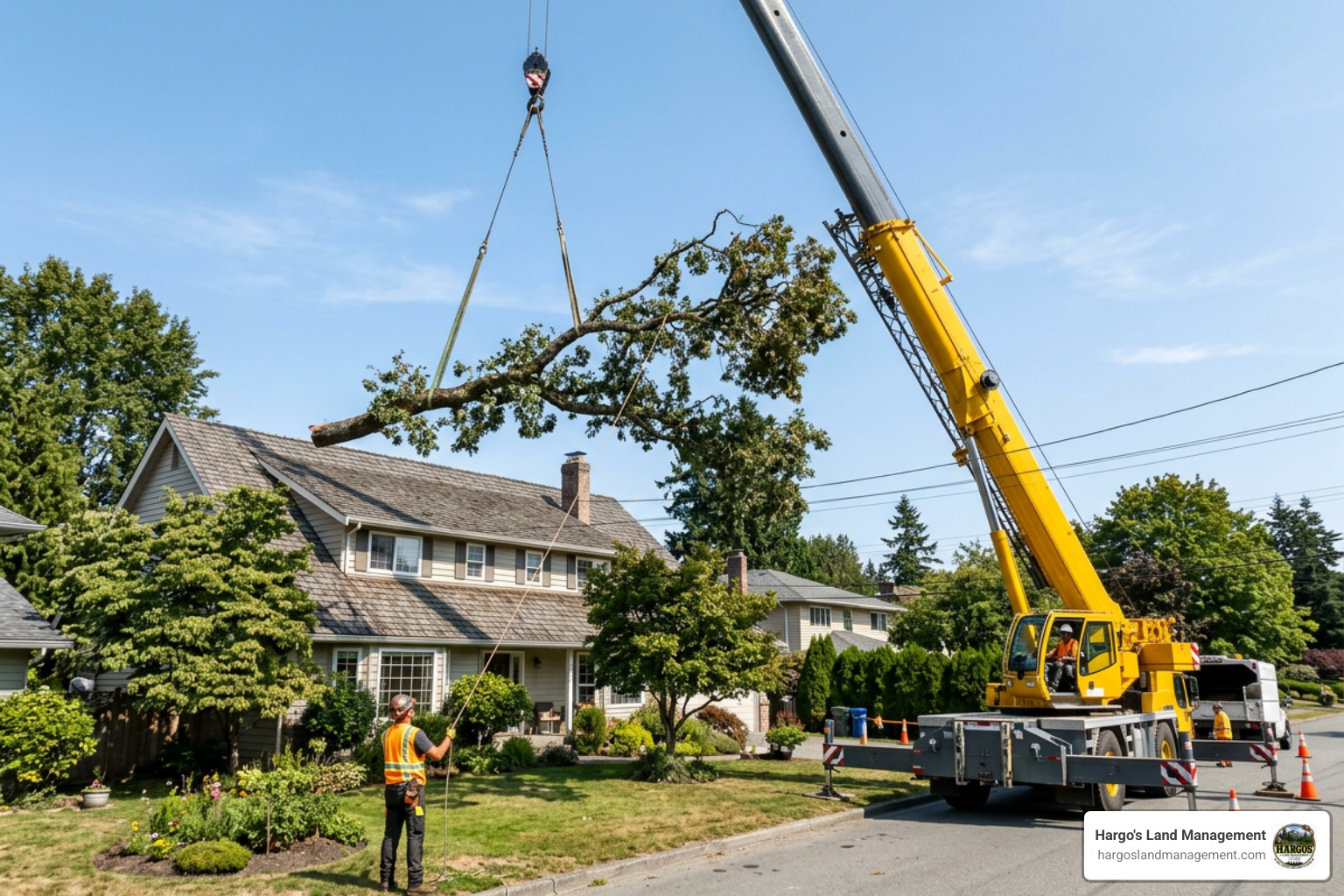
When a tree is too structurally decayed for an arborist to safely climb, or when ground drop zones are non-existent, crane assistance becomes essential. Precision equipment allows certified teams to perform complex removals with controlled vertical extractions.
Traditional drop-felling requires a clear drop zone at least 1.5 times the height of the tree. When access is restricted by surrounding structures, retaining walls, or power infrastructure, crane-assisted dismantling provides total control.
A certified crane operator stabilizes the upper boom over the tree canopy while a climber or bucket operator attaches heavy-duty slings to the target section. Once the piece is secured, the climber makes a clean cut, and the crane lifts the multi-ton section vertically up and over the house, landing it smoothly in a designated staging area on the street or driveway.

Specialized Rigging Protocols for High Risk Tree Removal
When site geometry prevents crane access, arborists rely on complex friction-based lowering setups. The rigging system relies on mechanical advantage to absorb dynamic energy so that heavy logs descend smoothly without jarring the tree stem or smashing the ground below.
Key rigging components include:
- Friction Brakes (Port-a-Wrap): Anchored to the base of an adjacent sturdy trunk, these steel friction cylinders allow ground crews to control thousands of pounds of falling wood with minimal hand effort.
- Arboricultural Pulleys and Rigging Blocks: Heavy-duty blocks set high in the tree direct lowering ropes along engineered load paths.
- Canopy Extraction and Sectional Cuts: Climbers remove lateral limbs first to shift the tree’s center of gravity before taking down the main stem in controlled blocks.
Curious to see these precision techniques in real-world environments? You can watch removing a hazardous tree in action or review our breakdown on taking down a large tree safely using professional rigging setups.
Permitting, Legal Protections, and Insurance Coverage
Navigating local municipal permits while a hazardous tree threatens your home can feel frustrating. Fortunately, specific legal frameworks and insurance guidelines exist to help homeowners act quickly.

Florida Statute §163.045 and Bypassing Local Permits
In municipalities with strict tree preservation ordinances, getting a permit to cut down a tree can take weeks or months. However, specific state laws streamline this process for emergency situations.
For instance, under Florida Statute §163.045, single-family residential property owners are legally permitted to bypass local government permit requirements, public hearings, and fee structures if an ISA-Certified Arborist or landscape architect certifies in writing that the tree presents an “unacceptable risk” under TRAQ evaluation standards.
This protection applies directly to heritage-class trees (often defined as 36″+ DBH). By utilizing valid arborist documentation to satisfy statutory hazard criteria, property owners can save anywhere from $2,000 to $8,000 in local municipal mitigation fees and replacement replanting costs.
Always retain signed, written risk reports in your home records to protect against potential municipal code enforcement disputes or neighbor liability claims.
Navigating Homeowners Insurance Claims for Hazardous Trees
A common question property owners ask is whether insurance covers proactive hazard removal.
- Proactive Removal of Intact Trees: Standard homeowners policies generally do not pay to remove a standing, intact tree simply because it is old, leaning, or decaying. Insurers view preventative maintenance as the homeowner’s responsibility.
- Storm Damage and Direct Impact: If a sudden storm, windstorm, or lightning strike causes a high-risk tree (or major limb) to fall and cause structural damage to a covered building (house, garage, shed), insurance will cover both structural repairs and the cost of tree extraction.
- Neighboring Tree Liabilities: If your neighbor’s hazardous tree drops a limb on your roof, your home insurance carrier typically pays your claim first, then pursues subrogation against the neighbor’s policy—especially if you previously sent documented written risk reports notifying the neighbor of the hazard.
When severe weather strikes, executing rapid storm cleanup prevents secondary water damage to your home.
High Risk Tree Removal Costs and Pricing Breakdown
Because hazardous removals demand specialized rigging, crane equipment, certified personnel, and legal risk documentation, high risk tree removal generally carries a 25% to 50% cost premium over standard tree felling.
The table below breaks down typical cost ranges based on tree size, complexity, and operational equipment:
Hazardous Tree Removal Cost Comparison Matrix
| Tree Category | Height / DBH Range | Standard Hazardous Removal Cost | Crane-Assisted Removal Cost | Key Operational Factors |
|---|---|---|---|---|
| Small Hazard | Under 30 ft | $485 – $1,100 | $3,500 – $4,500 | Minimal rigging, tight space handling |
| Medium Hazard | 30 ft – 60 ft | $1,100 – $2,400 | $3,500 – $5,500 | Moderate rigging, proximity to utility lines |
| Large Hazard | 60 ft – 80 ft | $2,400 – $4,800 | $4,500 – $7,500 | Advanced rigging, high limb weight, multi-cut stem |
| Very Large Hazard | 80+ ft | $4,200 – $8,500 | $5,500 – $9,500+ | Heavy structural decay, high tonnage lifts |
| Emergency Dispatch | Any size | +25% to +50% Surcharge | Included in total quote | 24/7 priority response, immediate mobilization |
Price Factors, Equipment Fees, and Add-On Services
Understanding the variables behind your estimate helps prevent billing surprises:
- Tree Size and Canopy Density: Taller trunks with massive lateral branches require more lowering cycles and labor hours.
- Access Constraints: If crew members cannot back a bucket truck or chipper directly up to the tree, manually hauling material out of a fenced yard increases labor costs.
- Stand-Alone Risk Assessment: Professional TRAQ-certified written evaluations cost between $185 and $385, though this fee is often credited toward the final job cost if you hire the company for removal.
- Stump Grinding Add-On: Mechanically grinding the remaining stump below grade typically costs $95 to $385, depending on diameter and surface root spread.
- Priority Emergency Dispatch: Requesting immediate dispatch during active storm events or overnight carries a 25% to 50% surcharge to cover emergency crew staging.
To schedule an evaluation for your property, explore our dedicated hazardous tree removal service details.
How to Choose Qualified High Risk Tree Service Contractors
Never choose a contractor for high-risk removals based solely on the lowest quote. Hiring an uncertified, uninsured operator to cut down a structurally compromised tree over your roof creates massive financial exposure.
Key Credentials Checklist
- ISA Certified Arborist on Staff: Verifies that the team understands tree physics, structural stability, and TRAQ safety standards.
- TCIA Safety Compliance: Demonstrates adherence to standard tree care safety standards (ANSI Z133).
- Comprehensive General Liability & Workers’ Compensation: Ensure the company holds at least $1,000,000 to $2,000,000 in general liability insurance, plus active workers’ compensation coverage for every crew member on site. Request certificates sent directly from their insurance agency.
- Specialized Rigging Capabilities: Check that the team utilizes rated rigging gear and technical methods engineered for safe, zero-impact removals.
Hargo’s Land Management Safety Protocols
At Hargo’s Land Management, we specialize in high-stakes arboricultural challenges, land clearing, and wildfire defensible space creation throughout El Dorado County (including Placerville and South Lake Tahoe). As a locally owned, licensed, bonded, and fully insured contractor, we bring high-quality, safety-focused execution directly to your property.
Our crews prioritize property protection on every project. Whether we are clearing hazardous snags around your driveway or removing massive compromised trees near your home, we utilize ground mats, zero-impact rigging, and precision lowering techniques.
Need comprehensive tree care or brush clearing to meet regional fire safe requirements? Learn more about our full range of residential and commercial solutions on our tree service page.
Frequently Asked Questions About High Risk Tree Removal
How quickly should a high risk tree be assessed and removed?
If you notice active failure signs—such as soil heaving at the root plate, a sudden new lean, or deep vertical trunk splits—the tree should be evaluated by a certified arborist within 24 to 48 hours. In severe situations where a tree is actively resting on utility lines or leaning precariously toward a structure after a storm, request priority emergency dispatch immediately.
Will homeowner insurance pay to remove a living high risk tree?
Generally, no. Homeowner’s insurance policies cover sudden, accidental damage caused by fallen trees rather than routine maintenance. If a living, structurally compromised tree has not yet fallen or damaged a covered structure, the policyholder is expected to cover removal costs out of pocket. However, if a storm causes part of the tree to break and strike your home, insurance will cover structural repairs and debris removal.
What qualifications should a high risk tree removal contractor hold?
A qualified contractor must carry comprehensive General Liability insurance and active Workers’ Compensation coverage specifically rated for high-risk tree work. Look for credentials such as ISA (International Society of Arboriculture) Certification, TRAQ (Tree Risk Assessment Qualification), and compliance with ANSI Z133 safety standards. Additionally, the contractor should offer zero-impact property protection methods, specialized rigging gear, or crane capabilities.
Conclusion
When dealing with a compromised tree, waiting and hoping for the best is a dangerous gamble. Structural decay, deep trunk splits, and root plate failures do not heal on their own; they deteriorate until gravity takes over. Prompt high risk tree removal by credentialed arborists protects your home, safeguards your family, and restores complete peace of mind.
At Hargo’s Land Management, we combine technical rigging experience, top-tier equipment, and local fire-safety knowledge to handle the toughest tree removals safely. Contact us today for a free on-site estimate, or visit our site to book online and secure priority scheduling with our team. Explore our full suite of professional solutions by visiting our Hazardous Tree Removal Services page today!
CUSTOMER REVIEWS & TESTIMONIALS
We strive to exceed your expectations. See what our customers have to say.















CONTACT US TODAY
Serving El Dorado and Surrounding Counties
Locally owned and operated since 2013. Use our live chat support to get in touch about your land management needs today.
Request a free evaluation and estimate by completing our online form or book an on-site appointment.
El Dorado County: El Dorado Hills, Cameron Park, Shingle Springs, Coloma, Placerville, Camino, Pollock Pines, South Lake Tahoe and more...
Amador County: Jackson, Ione, and Surrounding Towns
Sacramento County: Sacramento and Surrounding Cities
Placer County: Roseville, Rocklin, Auburn, and Everything In Between
Nevada County: Penn Valley, Nevada City, Grass Valley