Tree Topping Service Risks vs Safe Structural Pruning
Tree Topping Service: Know the Risks Before Cutting
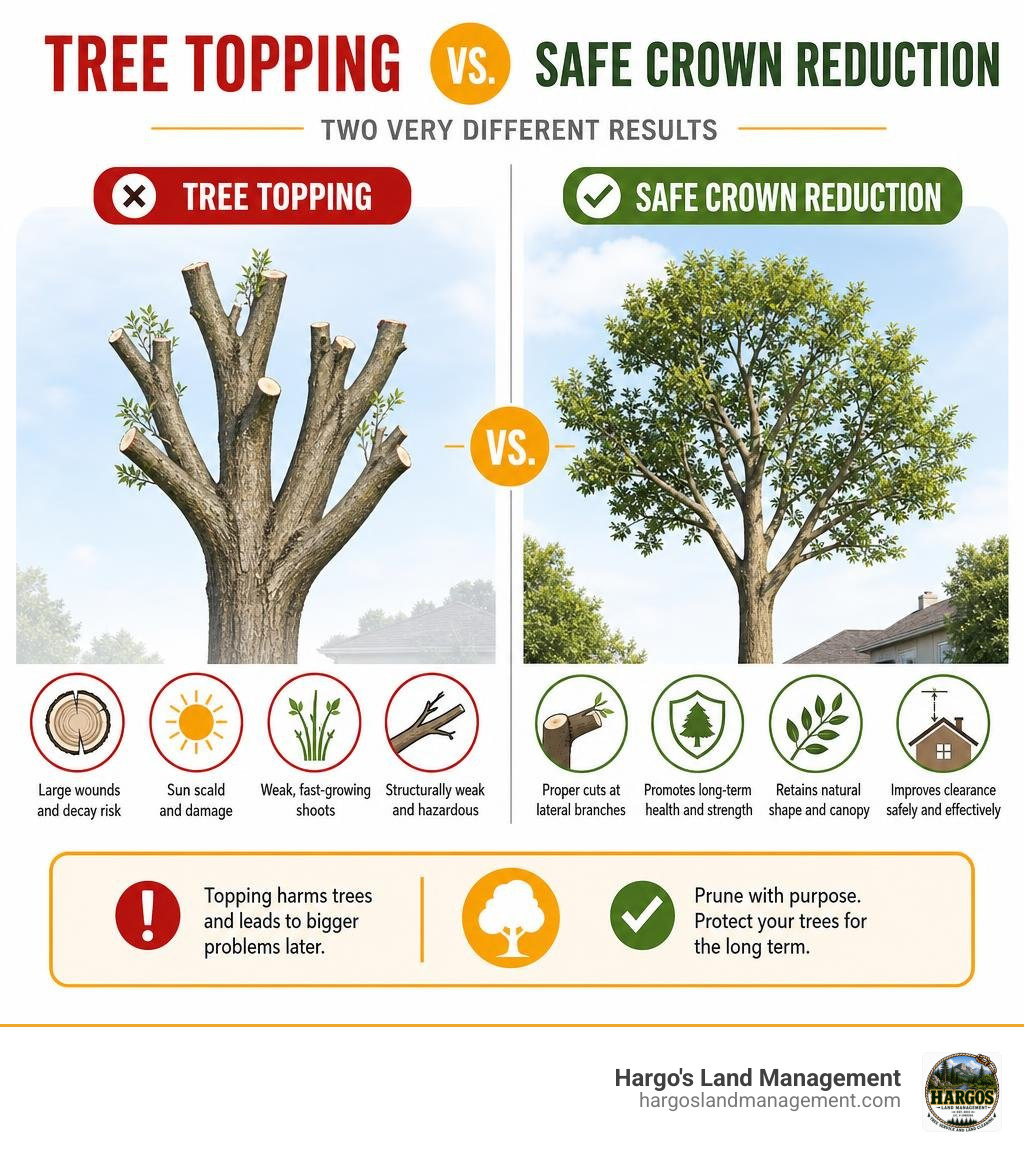
A tree topping service should not be routine tree maintenance. Topping means cutting major upper limbs back to stubs or very small branches. This can create decay, sun damage, and fast-growing shoots that are weakly attached.
For most trees, safer options include:
- Crown reduction to shorten selected limbs back to healthy lateral branches.
- Selective pruning to remove dead, damaged, low, or overextended branches.
- Tree removal when rot, severe lean, root failure, or major storm damage makes the tree unsafe.
In El Dorado County, this matters for more than curb appeal. Proper structural pruning can improve roof and driveway clearance, remove ladder fuels, and reduce hazardous limbs without stripping a tree of the foliage it needs to stay healthy. Severe topping may sometimes be used only as short-term emergency stabilization after crown breakage or an immediate clearance conflict, but it requires follow-up care and careful risk assessment.
Understanding Tree Topping Service and Severe Canopy Reduction
When homeowners see a tree growing uncomfortably close to a roofline or encroaching on utility lines, their first instinct is often to cut the top off. In the green industry, this practice is known as tree topping, heading, stubbing, or lopping. It involves making indiscriminate heading cuts across main vertical stems and lateral branches, leaving behind blunt stubs with little to no foliage.
While the immediate result is a dramatically shorter tree, this severe canopy reduction bypasses natural tree biology. Unlike standard pruning, topping ignores the tree’s natural growth points. When you cut a mature branch back to a random point rather than a healthy lateral limb capable of assuming the terminal role, the tree cannot properly seal the wound.
Understanding the structural science behind canopy clearance is essential before allowing any company to take a chainsaw to your mature canopy. Working with an ISA Certified Arborist ensures that your property receives genuine structural maintenance rather than irreversible damage. Leading industry organizations like the International Society of Arboriculture advocate for science-based canopy management rather than reckless cutting that leaves properties vulnerable.
What Is an Emergency Tree Topping Service?
There are limited situations where aggressive height reduction functions as a tactical risk-management tool. During extreme weather events—such as heavy Sierra snowstorms, ice accumulation, or high-wind microbursts—trees often experience fractured crowns and split main leaders. When broken, heavy wood dangles precariously over a residence or communication cables, waiting for an ideal aesthetic pruning cut is not always realistic.
In these urgent scenarios, an emergency stabilization cut is executed to remove immediate physical leverage and balance failing limbs. Emergency height reduction protocols are designed for high-risk clearances when immediate safety overrides standard aesthetics.
During severe storm damage tree hazards, stabilizing a splintered canopy protects lives and structures. However, these emergency cuts should always be treated as temporary interventions that require planned follow-up care or eventual removal, never as standard tree maintenance.
How Responsible Height Reduction Differs from Improper Topping
Responsible height reduction relies on understanding apical dominance—the hormonal mechanism by which the main central stem controls the growth of lateral branches below it. When a professional reduces height properly, cuts are placed just beyond the branch bark ridge and branch collar at a strong lateral limb.
To maintain healthy growth, that remaining lateral branch must be at least one-third the diameter of the stem being removed. This preserves the branch’s ability to compartmentalize decay while allowing sap flow to nourish the remaining limb. Improper topping cuts off these vital growth junctions entirely, leaving dead stubs that rot while shocking the root system.
5 Critical Risks and Long-Term Consequences of Tree Topping
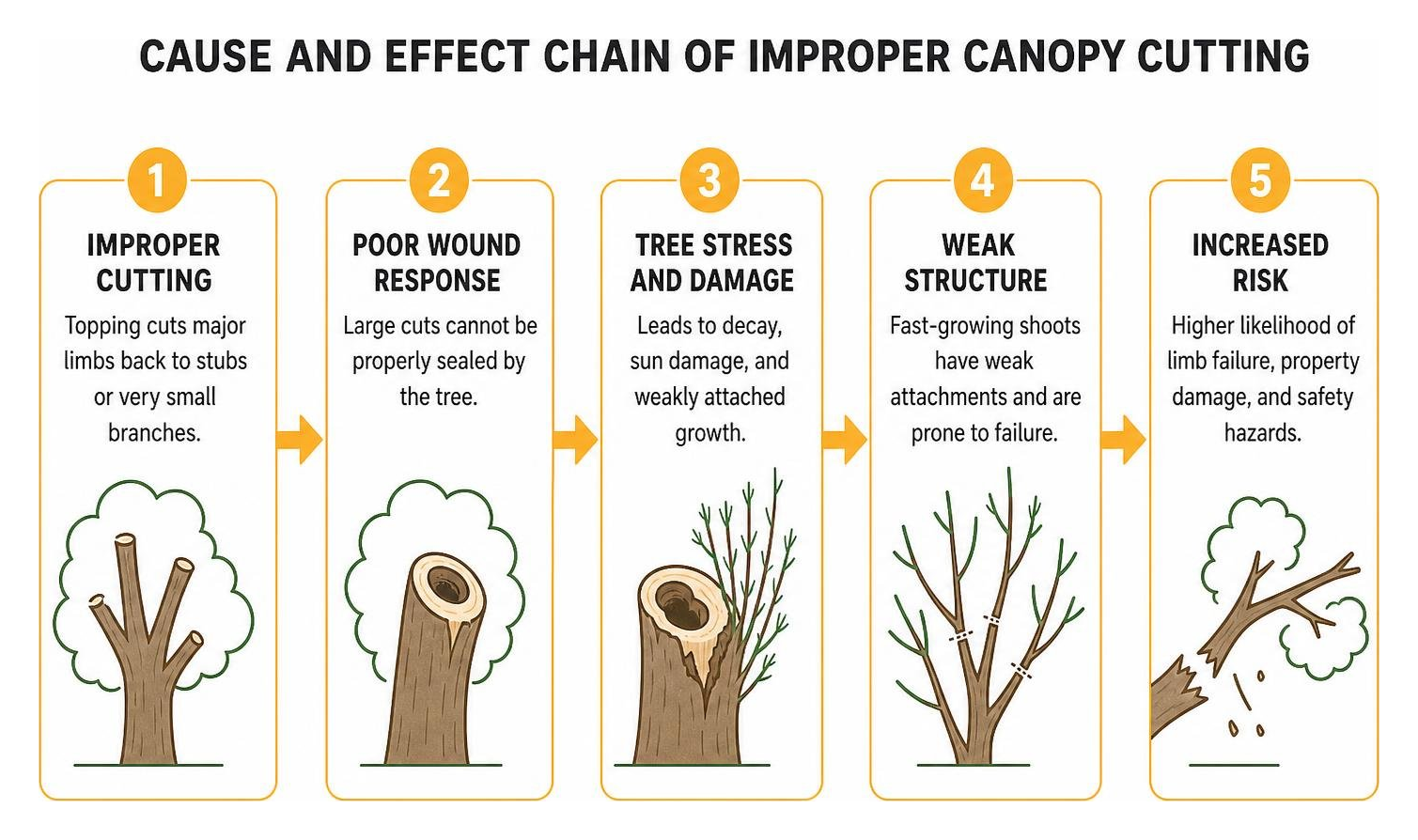
Before booking any service that promises to simply “chop the top off” to make your tree safe, it is vital to understand the hidden structural consequences. Far from making a tree safer, topping frequently creates an active hazard that costs significantly more to manage over time.
1. Severe Starvation Stress
Leaves are the food-producing factories of a tree. When a topping cut strips 50% to 100% of the leaf-bearing crown, the tree is thrust into immediate starvation. The root system, which depends on carbohydrates produced by the canopy, begins to die back. This shock triggers an emergency survival response, forcing the tree to expend its remaining energy reserves to push out emergency foliage.
2. Weak Epicormic Sprouting (Water Sprouts)
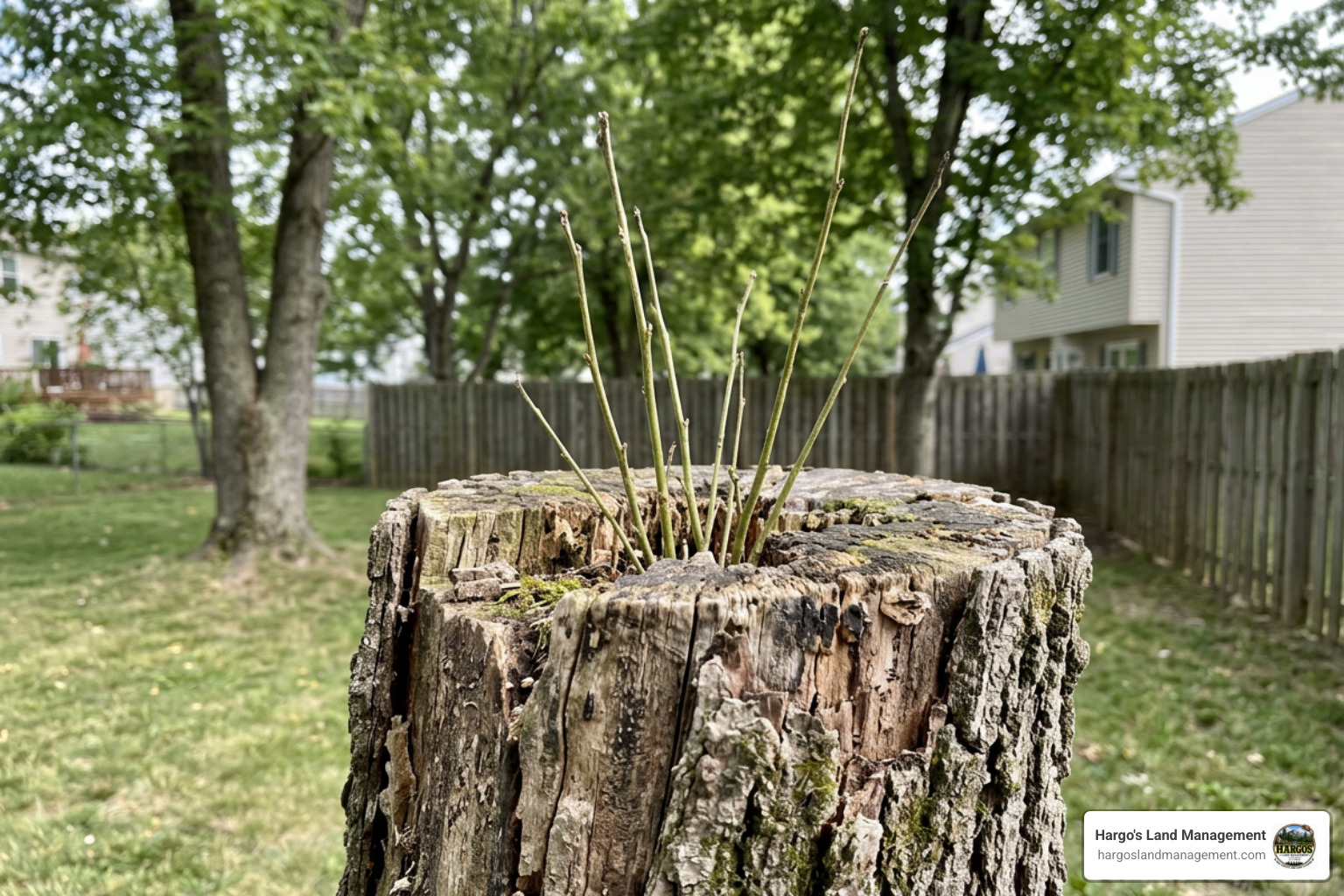
In response to sudden starvation, dormant buds beneath the bark erupt in dense clusters of rapid, vertical shoots known as water sprouts or epicormic growth. While a topped tree may look green again within a single season, these new shoots are anchored only in the outermost layer of wood—not within the structural core of the trunk. As they grow rapidly, they become heavy, brittle, and exceptionally prone to snapping off in moderate winds.
3. Accelerated Wood Decay and Fungal Infection
Large, blunt heading cuts leave broad exposed wood surfaces that mature trees cannot naturally heal. Fungi, wood-boring beetles, and carpenter ants enter through these cut stubs. As the interior wood rots downward into the trunk, it hollows out the structural framework beneath the heavy new shoots, creating a severe failure risk.
4. Sunscald and Bark Death
Branches inside a mature canopy are adapted to deep shade. When the protective upper foliage is suddenly sheared away, the bark on remaining structural limbs is exposed to intense solar radiation. This causes sunscald—destroying the cambium layer beneath the bark and leading to large dead patches, bark peeling, and further decay along the main limbs.
5. Increased Liability and Property Hazards
A topped tree quickly becomes an unpredictable liability. Because weakly attached water sprouts grow rapidly, the tree quickly regains its original height—often within just a few years—but with significantly weaker structural integrity. Homeowners facing high winds or heavy snow loads find that topped trees fail at far higher rates than unpruned or structurally pruned canopies.
To evaluate whether trees on your property have developed dangerous internal rot or weak attachments from past cutting, you can Protect Your Home With a Certified Arborist Tree Risk Assessment.
Safe Arboricultural Alternatives: Crown Reduction and Pruning
Rather than resorting to damaging heading cuts, modern arboriculture offers proven alternatives that achieve clearance, safety, and sightline goals while preserving tree health. Professional arborists evaluate whether safer techniques can accomplish a property owner’s objectives before taking aggressive action.

ANSI A300 Crown Reduction
The American National Standards Institute (ANSI) A300 pruning standards outline the proper method for reducing canopy height and spread. Crown reduction involves shortening limb length by cutting back to lateral branches that are large enough to assume the terminal growth role. This reduces overall height while maintaining the tree’s natural shape, preserving energy flow, and minimizing rapid water sprout generation.
Crown Thinning and Wind Load Reduction
For homeowners worried about tall trees blowing over in severe storms, crown thinning is the preferred solution. Thinning selectively removes specific secondary branches throughout the canopy without altering overall height. This allows wind to pass freely through the branches—reducing “wind sail” leverage on the root plate—while allowing sunlight to filter through to understory landscaping and roof surfaces.
Fuel Ladder Reduction and Defensible Space
In wildfire-prone environments across Northern California, tree maintenance is primarily about fire behavior. Lower limb removal (crown raising) and selective thinning eliminate ladder fuels that carry ground fires into mature canopies. Proper pruning creates crucial vertical separation from brush and structure clearances without compromising the tree’s vitality.
When a tree has suffered irreparable decay, extreme structural instability, or outgrown its space beyond what safe pruning can manage, safe Hazardous Tree Removal is far safer than leaving a decaying topped trunk standing near your home.
| Pruning Factor | Tree Topping | ANSI A300 Crown Reduction |
|---|---|---|
| Cut Placement | Arbitrary stubs between branch nodes | Targeted cuts at healthy lateral nodes |
| Foliage Loss | 50% to 100% stripped in a single service | Strictly limited (rarely exceeding 20-25%) |
| Wound Healing | Wounds remain open; rot spreads downward | Branch collar compartmentalizes and closes wound |
| Regrowth Type | Weak, brittle epicormic shoots (water sprouts) | Natural terminal branch extension |
| Future Risk | High likelihood of storm failure and rot | Enhanced structural balance and reduced wind drag |
| Long-Term Cost | High (frequent corrective cuts or removal) | Low (routine structural pruning cycles) |
Tree Topping Service Costs, Permits, and Regulations
Municipalities and counties increasingly regulate severe tree cutting to protect urban canopies, preserve property values, and maintain neighborhood safety. Many local jurisdictions classify improper topping as tree destruction or severe damage, which can trigger substantial fines—especially when dealing with protected heritage oaks, landmark pines, or native species.
Before undertaking major canopy modifications, property owners must verify municipal tree preservation ordinances. When full removal is required to manage a dangerous tree, completing the project with thorough Stump Grinding prevents tripping hazards and stops unwanted suckering from remaining root systems.
Average Cost of a Tree Topping Service vs Pruning
Tree service pricing varies significantly based on tree size, proximity to structures, equipment access, and site hazards. To help plan your property maintenance budget, consider these industry benchmarks for standard tree care operations:
- Tree Trimming (Small Trees): Averages $109
- Tree Trimming (Medium Trees): Averages $384
- Tree Trimming (Large Trees): Averages $728
- Tree Removal (Small Trees): Averages $385
- Tree Removal (Medium Trees): Averages $704
- Tree Removal (Large Trees): Averages $2,014
- Stump Grinding: Averages $278
Seasonal demand heavily influences project scheduling and contractor availability. Nationally and regionally, tree care demand peaks sharply during the early summer months of June and July (peaking at a demand index of 100), while dropping to its lowest point during the winter in December (demand index of 35). Scheduling your non-emergency structural pruning during late winter or early spring often allows for greater scheduling flexibility and better canopy visibility before spring leaf-out. Explore our complete range of Tree Service options to match your property’s specific timeline.
Hiring Standards and Contractor Red Flags
Because topping can permanently degrade a tree’s value and safety, vetting tree care contractors is critical. Quality tree care companies carry extensive operating experience—often ranging from 3 to 38+ years in business—and hold average customer satisfaction ratings between 4.00 and 5.00 stars across hundreds of verified local reviews.
When screening contractors, watch out for these major red flags:
- Recommending topping as a standard maintenance solution: Any company advertising routine topping for healthy mature trees is operating outside recognized arborist standards.
- Using climbing spikes on trees that are only being pruned: Climbing spikes puncture the living cambium layer, creating direct entry points for fungal pathogens and pests. Spikes should only be worn during full tree removals.
- Lacking verifiable credentials: Never hire an uninsured operator. Always require proof of general liability coverage, worker’s compensation insurance, and proper licensing.
- Refusing to provide detailed written contracts: Reliable estimates clearly describe the specific branches to be pruned, cut locations, cleanup procedures, and debris disposal terms.
Review our full lineup of licensed land care Services or easily Book Online for a comprehensive on-site consultation.
Frequently Asked Questions About Tree Topping
Does tree topping permanently stop upward growth?
No. Topping does not stunt upward growth; it accelerates it. In an emergency effort to replace lost foliage, the tree produces fast-growing water sprouts that shoot upward at two to three times the speed of normal branch growth. Within a few short seasons, the tree often reaches its original height, but with dense, chaotic, and structurally weak branches that require frequent, costly trimming.
Will tree topping reduce storm damage on my property?
Topping only provides temporary wind reduction at the expense of long-term stability. While the shortened profile may reduce leverage during the very first windstorm, the resulting interior rot and weakly anchored epicormic sprouts make the tree substantially more dangerous in subsequent seasons. Safe crown reduction and thinning reduce wind resistance while preserving the structural wood necessary to withstand heavy storms.
When is tree removal recommended instead of topping?
Tree removal is recommended whenever structural defects make safe pruning impossible. If a tree exhibits extensive internal rot, hollow main trunks, severe lean caused by root plate failure, widespread beetle infestation, or more than 40-50% crown dieback, attempting to save it through aggressive cutting is ineffective. In these cases, complete removal is the safest and most cost-effective path forward.
Conclusion: Choosing Safe Canopy Care Over Destructive Cutting
Protecting the mature trees on your property requires balancing safety, defensible space, and natural plant biology. While severe cutting may seem like a quick fix for overgrown limbs, the long-term costs of decay, brittle regrowth, and structural hazards far outweigh any temporary height reduction. By choosing certified arboricultural practices—such as ANSI A300 crown reduction, canopy thinning, and hazardous limb clearance—you enhance your property’s safety and curb appeal for decades to come.
At Hargo’s Land Management, we provide residential and commercial land solutions across El Dorado County, including Placerville and South Lake Tahoe. We are locally owned, licensed, bonded, and insured, offering free on-site estimates for fire-season safety, hazardous removals, and land clearing. Protect your home and land today by scheduling your professional defensible space clearing with our experienced team.
CUSTOMER REVIEWS & TESTIMONIALS
We strive to exceed your expectations. See what our customers have to say.













CONTACT US TODAY
Serving El Dorado and Surrounding Counties
Locally owned and operated since 2013. Use our live chat support to get in touch about your land management needs today.
Request a free evaluation and estimate by completing our online form or book an on-site appointment.
El Dorado County: El Dorado Hills, Cameron Park, Shingle Springs, Coloma, Placerville, Camino, Pollock Pines, South Lake Tahoe and more...
Amador County: Jackson, Ione, and Surrounding Towns
Sacramento County: Sacramento and Surrounding Cities
Placer County: Roseville, Rocklin, Auburn, and Everything In Between
Nevada County: Penn Valley, Nevada City, Grass Valley