Why Does Proof of Tree Removal Insurance Matter So Much?
Why Proof of Tree Removal Insurance Matters Before Work Starts
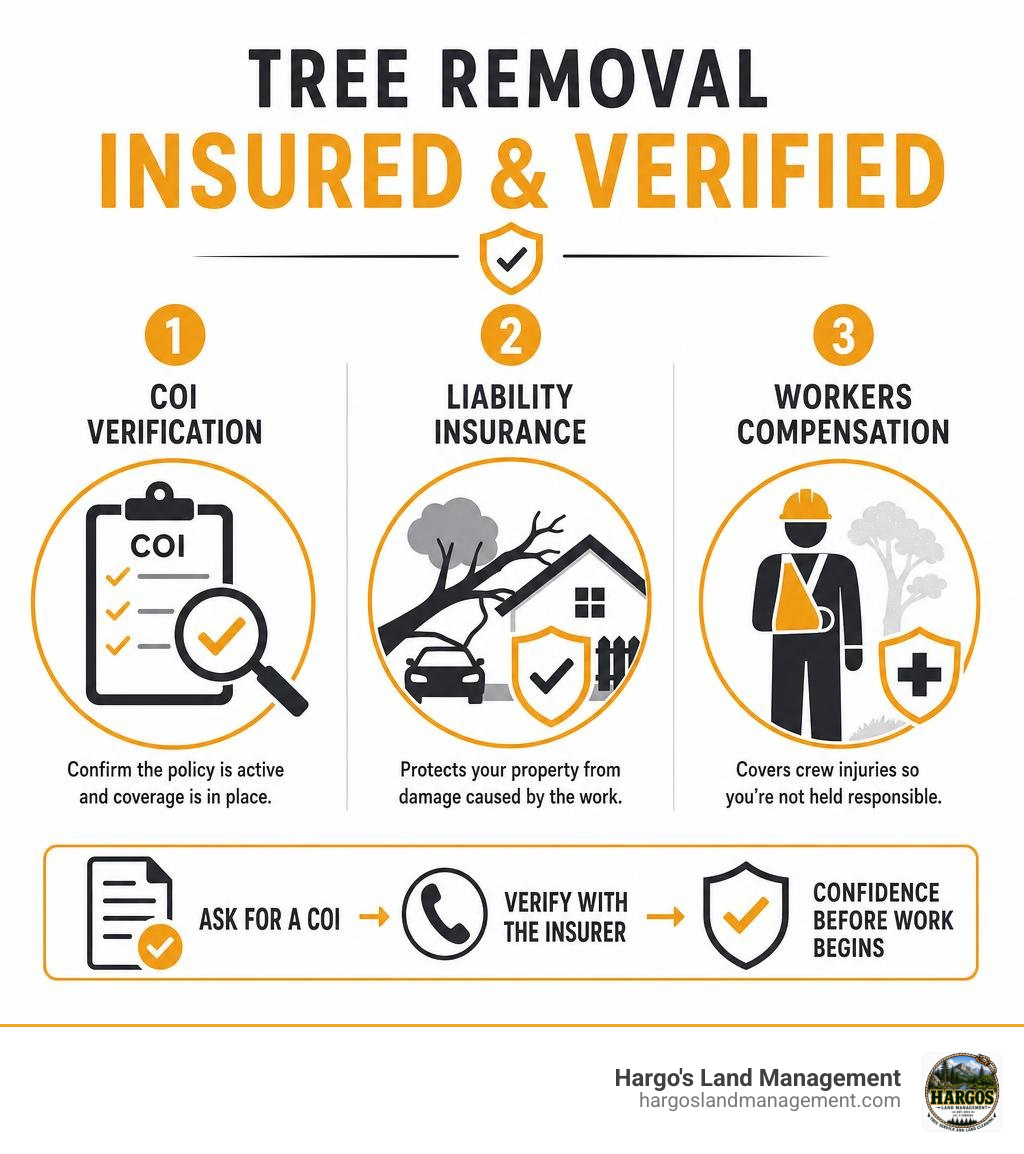
Before you hire a tree removal insured company, ask for a current Certificate of Insurance (COI) showing general liability and workers’ compensation coverage. Then call the listed insurance agent or carrier to confirm the policy is active, the coverage limits are adequate, and tree removal is included.
This simple check helps protect you if a falling limb damages a roof, fence, vehicle, or utility line – or if a crew member is injured on your property. Tree work involves heights, chainsaws, rigging, heavy equipment, and unpredictable storm damage. A low bid is not a bargain if an uninsured accident leaves you facing repairs or a claim.
A billing statement or verbal promise is not enough. A COI verified directly with the insurer is the proof that matters.
Essential Coverage: What a Tree Removal Insured Company Must Carry
Tree care is not basic lawn maintenance. Underwriters and safety agencies classify tree felling, structural rigging, and canopy pruning among the most hazardous trades in the country. Because crews operate heavy machinery, swing chainsaws at significant heights, and manipulate multi-ton wood sections, a reputable tree company must carry layered insurance policies to shield both the business and property owners from catastrophic loss.
Professional tree removal services typically cost anywhere from $200 to $2,000 depending on complexity, but an uninsured accident can easily generate hundreds of thousands of dollars in property damage or medical liabilities. To operate legally and safely, tree care contractors must carry several distinct forms of commercial coverage.
| Coverage Type | Primary Purpose | Who It Protects | Typical Policy Minimum |
|---|---|---|---|
| General Liability | Covers third-party property damage and non-employee bodily injury caused by operations. | Homeowners, neighbors, and commercial property owners. | $1,000,000 to $2,000,000 per occurrence |
| Workers’ Compensation | Covers on-the-job injuries, medical care, lost wages, and disability for crew members. | Tree care crew members, arborists, and ground personnel. | Statutory state limits |
| Commercial Auto | Covers liability and physical damage for work vehicles, bucket trucks, and trailers. | The public and business fleet on public roadways. | $1,000,000 combined single limit |
| Inland Marine (Equipment) | Protects mobile machinery, tools, and wood chippers in transit or on job sites. | Tree contractor’s operational equipment investments. | Varies by total fleet/gear valuation |
| Surety / License Bond | Guarantees contractual compliance, local code fulfillment, and ethical business conduct. | Consumers against fraudulent or unfinished project work. | State/city mandated thresholds |
General Liability Insurance Protection
General liability insurance serves as the foundational wall of defense for any tree care project. This policy steps in when an unexpected accident damages physical property or causes bodily harm to a bystander, client, or neighbor.
Consider standard operational hazards: a massive branch swings unexpectedly on a rigging rope and collides with your roofline, a trunk section bounces and cracks your concrete driveway, or falling debris tears down local utility lines. When addressing complex Hazardous Tree Removal, standard liability coverage ensures that the tree company’s insurer pays for all structural repairs, vehicle damages, and landscape restoration. Legitimate contractors maintain between $1 million and $2 million in liability limits, frequently backed by commercial umbrella policies for large-scale operations.
Workers’ Compensation and Crew Coverage
While general liability protects your real estate, workers’ compensation protects the individuals doing the dangerous physical labor. Tree work requires climbers to scale tall canopies and ground workers to feed heavy brush into industrial wood chippers.
If a groundsman suffers an injury from heavy debris or a climber falls from a bucket truck, workers’ comp pays for their emergency medical treatments, rehabilitation programs, disability benefits, and lost wages. When a contractor neglects this essential coverage, injured workers often turn to premises liability claims against the homeowner’s personal property policy to cover their devastating medical expenses.
Commercial Auto, Inland Marine, and Specialized Endorsements
Standard personal auto policies explicitly exclude commercial use when towing heavy trailers, hauling massive logs, or transporting industrial equipment. Tree services require commercial auto insurance to cover bucket trucks, dump trucks, and utility rigs driving between jobsites.
Furthermore, standard commercial property insurance only covers tools kept inside a primary shop or office. Mobile gear like chainsaws, ropes, stump grinders, and wood chippers require inland marine endorsements. Specialized machinery requires specific coverage riders; for instance, executing a Stump Grinding Service Costs Tools and Safety Tips job involves high-speed underground cutting wheels, which insurers frequently exclude without a dedicated stump-grinding endorsement.

Step-by-Step Guide to Verifying Contractor Insurance

Verifying coverage takes less than ten minutes and prevents severe legal exposure. Never accept a contractor’s casual assurance that they are “fully licensed and insured.” Always demand written proof and authenticate it directly through the issuing insurance agency before equipment touches your property.
How to Verify a Tree Removal Insured Company Certificate of Insurance
Follow these systematic steps to confirm active, uncompromised insurance coverage:
- Request a Certificate of Insurance (COI): Ask the contractor to have their insurance agent send a COI directly to your email address or provide a current copy.
- Inspect Policy Types and Limits: Review the document to verify active General Liability (minimum $1,000,000 per occurrence) and statutory Workers’ Compensation coverage.
- Check Effective Dates: Ensure the policy period is current. Reject certificates showing expired policy dates.
- Verify Specific Operations: Confirm there are no policy exclusions for high-altitude climbing, hazardous felling, or specialized mechanical services like stump grinding.
- Call the Issuing Broker: Locate the insurance agent’s contact details printed directly on the top or bottom of the COI. Call them directly to confirm that the policy is currently in force and premiums are paid in full.
- Request to be Named as Certificate Holder: For extensive tree projects, ask the agent to add your name and address in the “Certificate Holder” box, ensuring you receive immediate notification if the policy gets canceled during your project.
Certificate of Insurance vs. Billing Statements
Many homeowners mistakenly accept an insurance invoice, quote slip, or billing statement as proof of coverage. This is a dangerous mistake.
An insurance billing statement merely shows that a policy was quoted or that an invoice was generated at some point in time. It provides zero legal evidence that the contractor actually paid the installment, kept the policy active, or avoided immediate cancellation for non-payment. A formal ACORD Certificate of Insurance, validated by the issuing broker, is the only document that confirms active commercial underwriting.
What to Do If a Tree Removal Insured Company Cannot Provide Proof
If a tree contractor stalls, makes excuses, or refuses to provide a verifiable COI, immediately cease all negotiations. Never hire a contractor who demands large upfront cash deposits while failing to supply official licensing and insurance documents.
Uninsured operators often resort to high-pressure, door-to-door sales tactics following severe weather. Protecting your home and landscape means partnering with verified pros; Save Your Yard by Booking a Full Tree Removal Service Today with an established crew that openly supplies complete coverage documentation.
The True Risks of Hiring an Uninsured Contractor for High-Hazard Tree Work
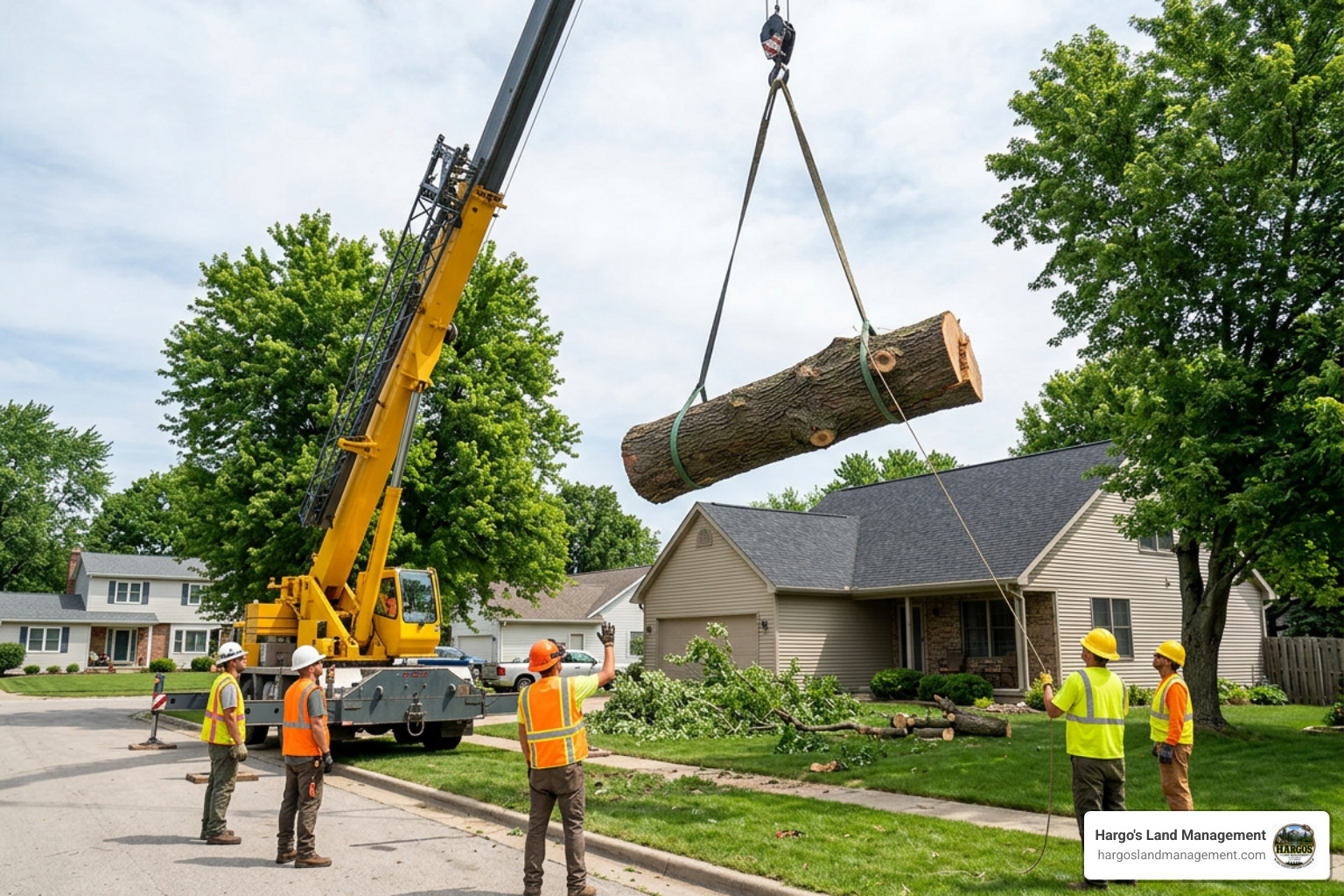
Hiring an uninsured tree cutter to save a few dollars on an estimate creates enormous financial vulnerability. When chainsaws, rigging blocks, and heavy timber meet unpredictable physical forces, minor mistakes can escalate into hundreds of thousands of dollars in liability.
Homeowner Liability and Personal Injury Lawsuits
If an uninsured worker slips from a ladder, drops a heavy limb onto their leg, or suffers a chainsaw kickback on your property, who pays the hospital bill?
Because personal health insurance policies frequently deny claims arising from commercial workplace injuries, the injured worker’s legal recourse is to sue the property owner under premises liability. When Taking Down a Large Tree, physical hazards multiply. Without active workers’ compensation on the contractor’s side, you may find yourself defending a personal injury lawsuit, risking personal savings, property equity, and retirement assets to cover an injured laborer’s medical bills and lost earnings.
Property Damage and Denied Homeowner Insurance Claims
What happens if an uninsured tree cutter drops a 3,000-pound trunk through your living room ceiling? You might assume your homeowner’s insurance policy will step in without issue.
However, many residential property insurance policies contain exclusions regarding structural damages caused by unpermitted, unlicensed, or illegal contractor operations. Your insurer may deny the claim outright due to contractor negligence, or they might pay for basic immediate repairs and aggressively pursue the uninsured operator—leaving you stuck paying a steep deductible and enduring higher insurance premiums for years to come.
Understanding Insurance Costs, Licensing, and Bonding Requirements
Commercial tree care insurance is a significant investment. Understanding what goes into insurance pricing clarifies why professional companies charge realistic market rates rather than rock-bottom prices.
Tree Service Business Insurance Costs and Factors
Tree care insurance premiums reflect the inherent danger of working with heavy machinery at heights. On average, standard commercial coverage includes several ongoing expenses:
- General Liability: Basic $1 million policies cost around $40 to $138 per month, while comprehensive high-limit policies ($1M to $2M+ coverage) range from $3,000 to $6,000 annually.
- Workers’ Compensation: Averages roughly $186 per month per employee, scaling upward significantly based on annual payroll and high-risk climbing duties.
- Tools and Equipment (Inland Marine): Averages $57 per month to protect vital field machinery, with high-value assets over $2,500 scheduled individually.
Underwriters calculate these premiums by evaluating a company’s past claims history, employee count, safety record, equipment values, and geographic service locations. A company that maintains continuous, year-round insurance demonstrates financial stability and strict risk control.
Licensing and Bonding vs. Liability Insurance
Insurance, licensing, and bonding fulfill three separate consumer protection roles:
- Licensing: Confirms that a business meets local or state municipal standards to legally operate. In heavily regulated states, specialized contractor licensing is mandatory for tree and canopy management.
- Bonding (Surety Bonds): Protects consumers financially if a contractor walks away without finishing the contracted project, fails to pay for required permits, or damages municipal infrastructure.
- Insurance: Pays directly for physical property destruction and workplace injuries.
In addition to state licenses, working with an ISA Certified Arborist ensures that crew leaders hold verified biological and structural credentials. You can proactively Protect Your Home with a Certified Arborist Tree Risk Assessment to identify canopy defects, disease vectors, and structural failure risks long before trees threaten your home.
Frequently Asked Questions About Tree Removal Insurance
How much liability insurance should a tree service carry?
A reputable tree removal business should carry a minimum of $1,000,000 per occurrence and $2,000,000 aggregate in commercial general liability insurance. For complex residential projects involving large cranes, steep slopes, or proximity to commercial buildings, top-tier contractors carry $2,000,000 to $3,000,000 or more in combined liability and commercial umbrella coverage.
Does homeowners insurance cover damage if an uninsured worker gets hurt?
Your homeowner’s policy might provide limited personal liability protection, but it is never designed to serve as primary workers’ compensation for commercial crews. If an uninsured worker suffers a severe injury on your land, their medical bills can easily exceed standard policy limits ($100,000 to $300,000), exposing your personal bank accounts and assets to direct civil litigation.
Can a tree company bill my insurance carrier directly for storm damage?
Yes. Established tree care companies coordinate directly with major insurance carriers to streamline the claims process following severe weather events. By managing photographic evidence, tree hazard logs, and direct adjuster billing, specialized crews perform Storm Damage Tree Removal Insurance Claims and Safe Cleanups with minimal out-of-pocket stress for the homeowner.
Protect Your Property with Verified Tree Professionals
Removing dead, hazardous, or overgrown trees is crucial for maintaining structural safety, preserving landscape beauty, and creating vital defensible space against regional wildfire threats. However, the company you choose to handle these high-risk operations makes all the difference between a seamless project and an expensive legal nightmare. Always demand and verify a current Certificate of Insurance before allowing any work to begin.
At Hargo’s Land Management, we take property safety and consumer protection seriously. As a locally owned, fully licensed, bonded, and insured tree care contractor serving El Dorado County—including Placerville and South Lake Tahoe—we provide reliable Tree Service, hazardous removals, land clearing, and fire-season defensible space creation. We back all of our work with comprehensive liability coverage, full crew protection, modern equipment, and free on-site estimates. Reach out to our team today to schedule your assessment and protect your property with proven industry professionals.
CUSTOMER REVIEWS & TESTIMONIALS
We strive to exceed your expectations. See what our customers have to say.















CONTACT US TODAY
Serving El Dorado and Surrounding Counties
Locally owned and operated since 2013. Use our live chat support to get in touch about your land management needs today.
Request a free evaluation and estimate by completing our online form or book an on-site appointment.
El Dorado County: El Dorado Hills, Cameron Park, Shingle Springs, Coloma, Placerville, Camino, Pollock Pines, South Lake Tahoe and more...
Amador County: Jackson, Ione, and Surrounding Towns
Sacramento County: Sacramento and Surrounding Cities
Placer County: Roseville, Rocklin, Auburn, and Everything In Between
Nevada County: Penn Valley, Nevada City, Grass Valley