
Storm Damage Tree Removal: Insurance Claims and Safe Cleanups
Immediate Action Steps for Storm Damage Tree Removal
When severe weather strikes, evaluating the wreckage on your property can feel overwhelming. Emergency triage is all about prioritizing life safety first, structural preservation second, and site clearance third. Before grabbing a chainsaw or stepping out into the yard, take a breath and assess hazards from a safe distance.
Securing the Site and Utility Wire Hazards
Downed power lines present one of the most lethal hazards following high winds or ice storms. A snapped live wire can energize not just the line itself, but the surrounding ground, moisture, and metal fences within a radius of 35 feet or more.
- Assume every line is live: Never touch, move, or approach a downed utility wire or a tree entangled in wires.
- Alert emergency services: Call 911 immediately if a line is sparking, touching a building, or blocking a road.
- Notify the utility provider: Report the outage and wire hazard directly to your electric company.
- Keep everyone away: Block off the area so family members, pets, and neighbors stay well clear.
Only after utility companies declare the area electrically safe should anyone begin physical work on or near trees touched by power lines.
Documenting Hazards for Emergency Storm Damage Tree Removal
Before moving a single branch or hiring an emergency response crew, take extensive date-stamped photos and videos of the damage. Insurance claim adjusters rely heavily on visual evidence recorded right after the event.
To ensure your documentation stands up during the claim process:
- Capture wide-angle shots: Show the full context of the scene, including the overall tree, the impacted structure, driveway, or power corridor, and weather condition indicators.
- Take close-up photos: Document structural cracks, snapped trunks, broken branches, torn bark, and uplifted root balls.
- Show structural impacts clearly: Photograph where limbs or trunks rest on roofs, gutters, vehicles, or fences.
- Collect detailed estimates: Request an itemized written quote from a professional crew that details equipment needs, crew size, and labor costs.
Having high-quality proof simplifies working with your insurance carrier and helps speed up emergency response dispatch.
Evaluating Tree Health: Save vs. Remove Decisions
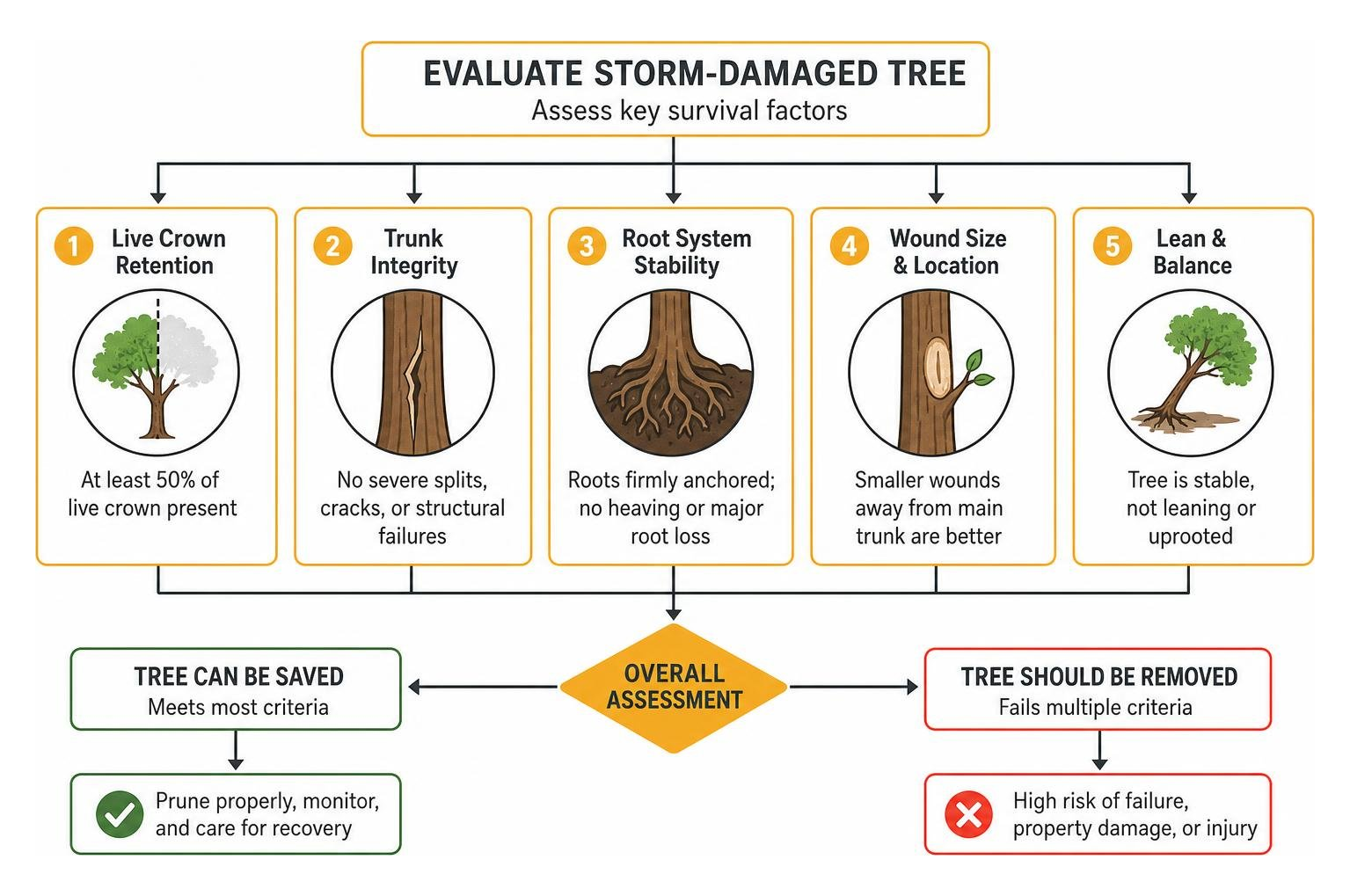
Not every storm-damaged tree is beyond saving. Trees possess remarkable capacity to seal wounds and regrow if the main trunk remains structurally sound. Deciding whether a tree can be rehabilitated or requires complete storm damage tree removal depends on several structural baselines.
Applying the 50 Percent Crown Rule and Wound Inspection
A tree’s canopy (crown) is its primary engine for producing food through photosynthesis. As a general rule of thumb, if a tree retains at least 50 percent of its live crown, it has a strong chance of survival.
When inspecting a damaged tree’s canopy and trunk:
- Evaluate crown intactness: If less than 50 percent of the original foliage and healthy branches remain, the tree will struggle to produce enough food to survive the next growing season and is often a candidate for removal.
- Check the main leader: Loss of the central upward stem (the leader) in mature trees creates structural weaknesses and weak branch attachments down the road.
- Examine wound sizes: A bark wound or limb break 2 to 3 inches in diameter on a major branch can often seal over within a couple of growing seasons. However, wide bark tears stripping large sections of bark down the main trunk invite decay fungi and wood-boring insects.
Identifying Structural Failure and Unstable Leans
Some damage compromised structural integrity beyond repair, making the tree an immediate or delayed safety hazard:
- Stem Failure and Split Trunks: Deep vertical cracks down the trunk or a fully split main fork mean the tree’s structural architecture has failed. Such trees cannot safely support their own weight.
- Root Lifting and Post-Storm Leans: If a tree survived the initial gusts but shows a new post-storm lean, inspect the base. Soil mounding, fresh soil cracking, or exposed root plates indicate root severance. These trees can collapse without warning days or weeks later as soil dries out or shifts.
- Widow Makers: Large limbs snapped off but suspended high up in the canopy—known in our industry as “widow makers”—pose grave danger to anyone walking underneath.
For additional guidance on assessing immediate storm threats, professional structural evaluation and safety planning are essential prior to undertaking hazardous work.
Navigating Homeowners Insurance Claims for Fallen Trees
Understanding how property insurance treats storm damage helps set realistic expectations regarding claim payouts and out-of-pocket deductibles.
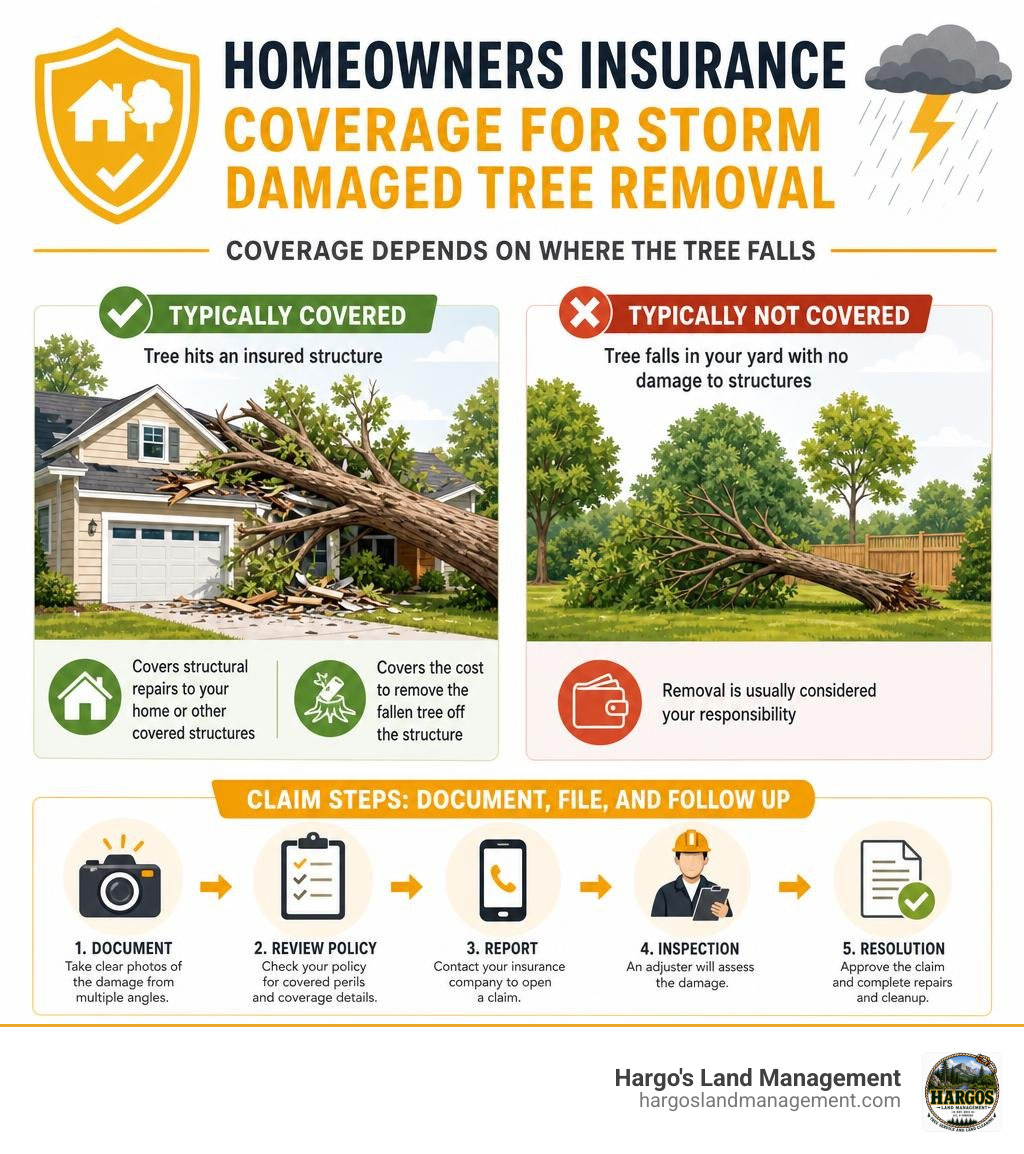
Photo Documentation and Claim Filing Steps
Standard homeowners insurance policies cover tree damage caused by covered perils, such as windstorms, lightning, hail, or heavy ice accumulation. However, coverage generally hinges on where the tree fell:
- Tree Hits an Insured Structure: If a tree or heavy limb falls on your home, garage, shed, or covered deck, insurance typically pays for both structural repairs and the cost to remove the fallen tree off the structure.
- Tree Blocks Vital Access: If a fallen tree blocks a primary driveway or handicap-accessible walkway—preventing you from entering or leaving your home—most policies cover removal to restore access.
- Tree Falls Harmlessly in the Open Yard: If a tree falls in an open area without striking an insured structure or blocking essential access, insurance standardly does not pay for tree removal or hauling debris away.
Maximizing Coverage for Storm Damage Tree Removal
To maximize your coverage and streamline the process with your adjuster:
- Submit documentation immediately: Send date-stamped photos, videos, and your storm damage timeline to your adjuster right away.
- Obtain detailed, itemized quotes: Avoid vague receipts. Ensure your written estimate clearly separates the cost of lifting the tree off the house or driveway from general yard cleanup.
- Understand emergency pricing factors: Emergency tree operations often require specialized equipment (such as cranes, bucket trucks, or heavy loaders) and rapid crew dispatch. Rates during a widespread storm event can run 1.5x to 2x higher than standard scheduled maintenance due to emergency hazard conditions.
- Clarify policy limits and deductibles: Ask your agent about specific caps on tree debris removal (often around $500 to $1,000 per tree or $2,000 per storm event) and how your deductible applies.
Professional Arborist Services vs. DIY Risk Management
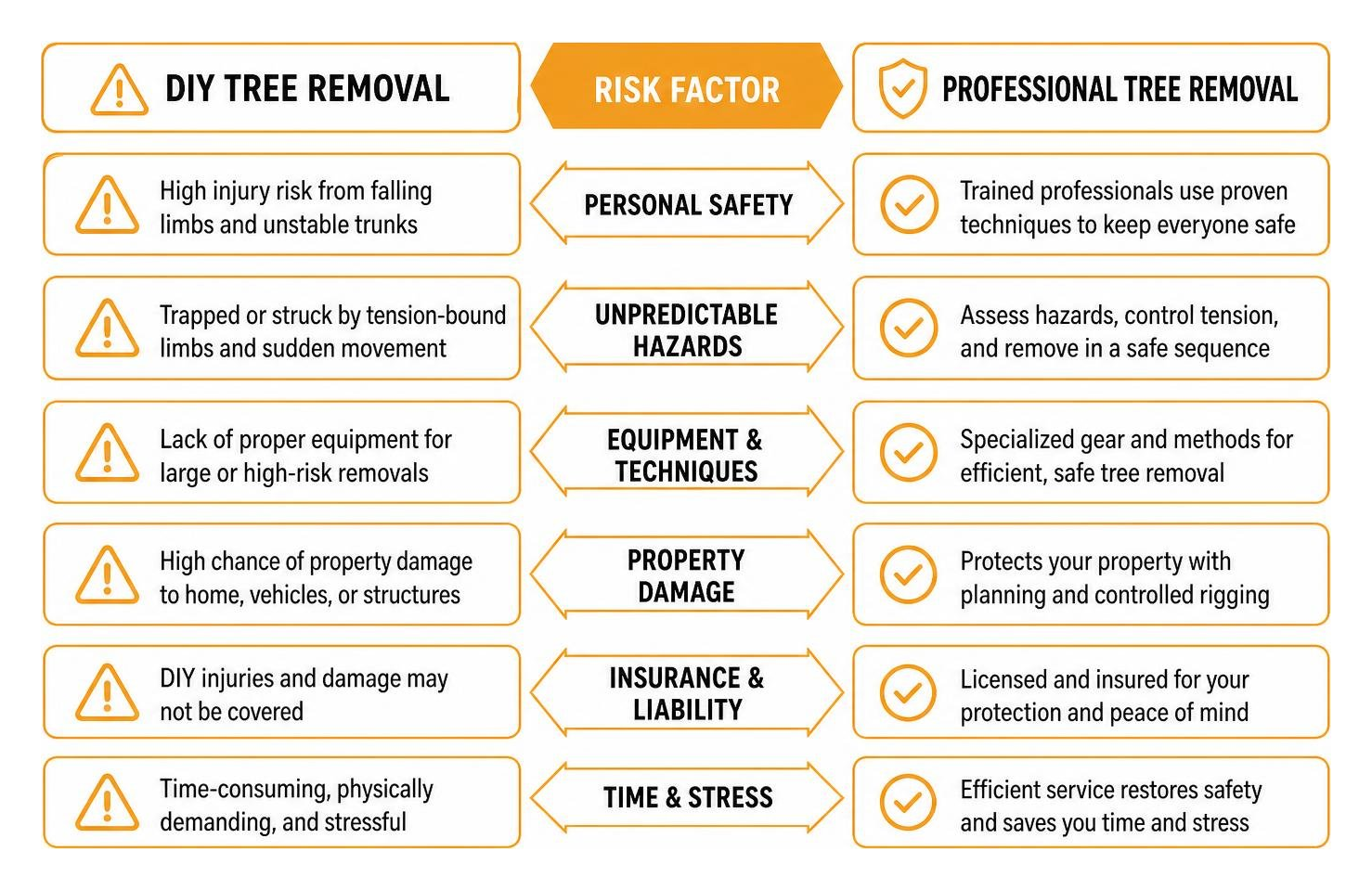
Attempting DIY cleanup on severe tree damage is extremely hazardous. Broken trunks, tension-bound limbs, and high-altitude widow makers present unpredictability that requires specialized training and heavy equipment.
Avoiding Storm Chasers and Verifying Credentials
Following major weather events, unvetted contractors often travel into damaged neighborhoods offering quick, cash-in-hand tree removal. Hiring unaccredited “storm chasers” exposes property owners to severe legal liability and secondary property damage.
To safeguard your home and wallet, always verify credentials before signing a contract:
- Require proof of insurance: Demand current certificates for general liability and workers’ compensation insurance sent directly from the insurer. If an uninsured worker is injured on your property, you could be held liable.
- Verify professional credentials: Look for ISA (International Society of Arboriculture) Certified Arborists or TCIA (Tree Care Industry Association) accredited companies.
- Avoid door-to-door solicitors: Reputable local firms rarely knock on doors soliciting emergency work after a storm.
- Get a written contract: Never hand over full payment upfront. Ensure the contract clearly defines the scope of work, debris hauling terms, total costs, and final payment upon satisfactory completion.
For property owners facing heavy storm clearing requirements, consulting certified and insured local crews ensures that hazardous conditions are resolved safely and efficiently.
Natural Target Pruning and Debris Disposal
When pruning damaged branches on trees that can be saved, proper technique prevents long-term decay:
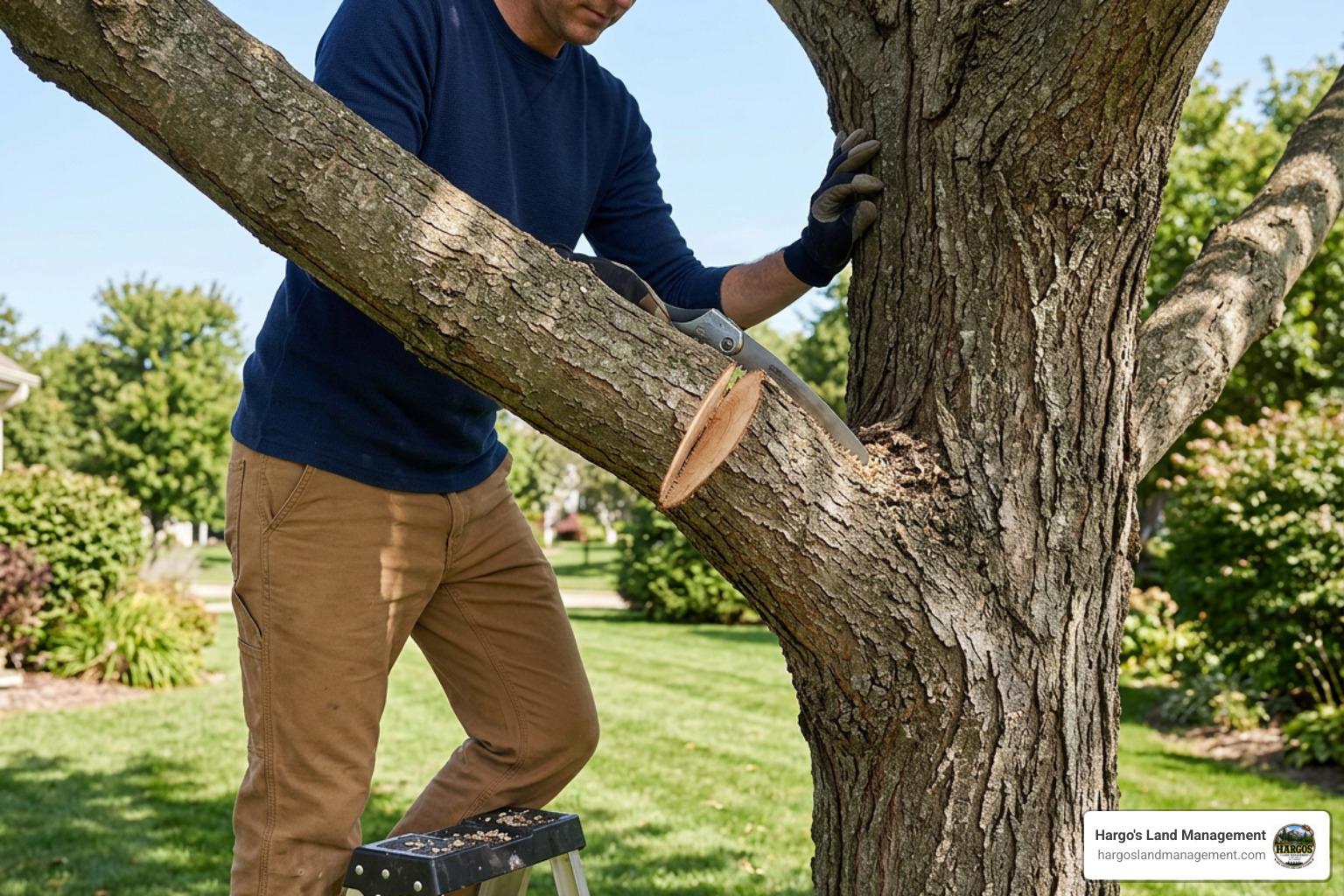
- Use the three-step pruning cut: To trim broken limbs without tearing bark down the trunk, make an undercut 12 inches from the trunk, followed by a top cut slightly further out to drop the branch, and finish with a clean cut just outside the branch bark collar.
- Never “top” a storm-damaged tree: Cutting main leaders down to stubs causes weak, rapid sucker growth (epicormic sprouting) that creates severe structural hazards five years later.
- Skip tree paint and wound dressings: Research shows that wound paint traps moisture and accelerates fungal rot. Trees seal their own wounds naturally through compartmentalization.
- Manage wood waste responsibly: Process logs and smaller brush into beneficial mulch using wood chippers. Clean timber can also be split and stacked for firewood once properly seasoned.
Proactive Care: Preventing Future Storm Damage
The best time to handle a storm damage emergency is before the storm ever hits. Routine preventative care strengthens canopy architecture and significantly reduces failure rates during extreme weather events.
- Schedule pre-season hazard inspections: Have a certified arborist inspect mature trees for internal hollows, fungal fruiting bodies, split crotches, or root decay.
- Prune for wind resistance: Crown thinning removes select secondary branches to cut down the “wind sail” effect, allowing high winds to pass through the canopy with less resistance.
- Install structural cabling and bracing: High-value mature trees with narrow V-shaped crotches or twin leaders can be reinforced using flexible steel cabling and threaded rods high in the canopy.
- Phase out brittle tree species: Avoid planting weak-wooded or fast-growing species like Bradford pear, silver maple, boxelder, or Siberian elm near homes, driveways, or power lines.
- Maintain soil and root health: Avoid compacting soil over root zones with heavy vehicles, and maintain adequate mulch beds to prevent root stress during seasonal dry spells.
Frequently Asked Questions
How quickly should storm damage tree removal be completed?
Immediate hazards—such as trees resting on houses, blocking main access roads, or dangling near power lines—should be addressed as quickly as possible. For non-emergency situations where a tree is damaged but stable in an open yard, property owners can safely wait a few days or weeks for storm-response prices to settle down before scheduling removal.
Does homeowners insurance cover tree removal if no structure is hit?
Generally, no. Standard insurance policies do not pay for removing or hauling away trees that fall harmlessly in open yards or woods without damaging covered structures or blocking primary access driveways.
Can a leaning tree be saved after high winds?
If a mature tree develops a sudden lean following high winds and shows lifted soil or cracked roots at its base, it almost always requires removal. A compromised root system cannot reliably anchor the tree against future wind loads. Young, small trees leaning less than 45 degrees may occasionally be straightened and staked, but mature trees with severe root failure present unacceptable safety risks.
Conclusion
Navigating post-storm destruction demands a clear head and a safety-first mindset. By securing hazardous sites immediately, documenting damage thoroughly for insurance adjusters, and trusting certified professionals for complex tree work, you protect both your family and your property investment.
At Hargo’s Land Management, we specialize in residential and commercial tree services, heavy hazard clearing, and wildfire defensible space creation throughout El Dorado County, including Placerville and South Lake Tahoe. As a locally owned, fully licensed, bonded, and insured team, we provide free on-site estimates and rapid, safety-focused service to keep your land secure year-round.
If recent storms have left hazardous trees on your property—or if you want to prepare your land before the next severe weather or fire season—explore our expert defensible space clearing services and contact our team today to schedule your assessment.
CUSTOMER REVIEWS & TESTIMONIALS
We strive to exceed your expectations. See what our customers have to say.















CONTACT US TODAY
Serving El Dorado and Surrounding Counties
Locally owned and operated since 2013. Use our live chat support to get in touch about your land management needs today.
Request a free evaluation and estimate by completing our online form or book an on-site appointment.
El Dorado County: El Dorado Hills, Cameron Park, Shingle Springs, Coloma, Placerville, Camino, Pollock Pines, South Lake Tahoe and more...
Amador County: Jackson, Ione, and Surrounding Towns
Sacramento County: Sacramento and Surrounding Cities
Placer County: Roseville, Rocklin, Auburn, and Everything In Between
Nevada County: Penn Valley, Nevada City, Grass Valley