
Heavy Brush Removal Equipment Comparison for Landowners
Choosing Heavy Brush Removal Equipment for Your Property
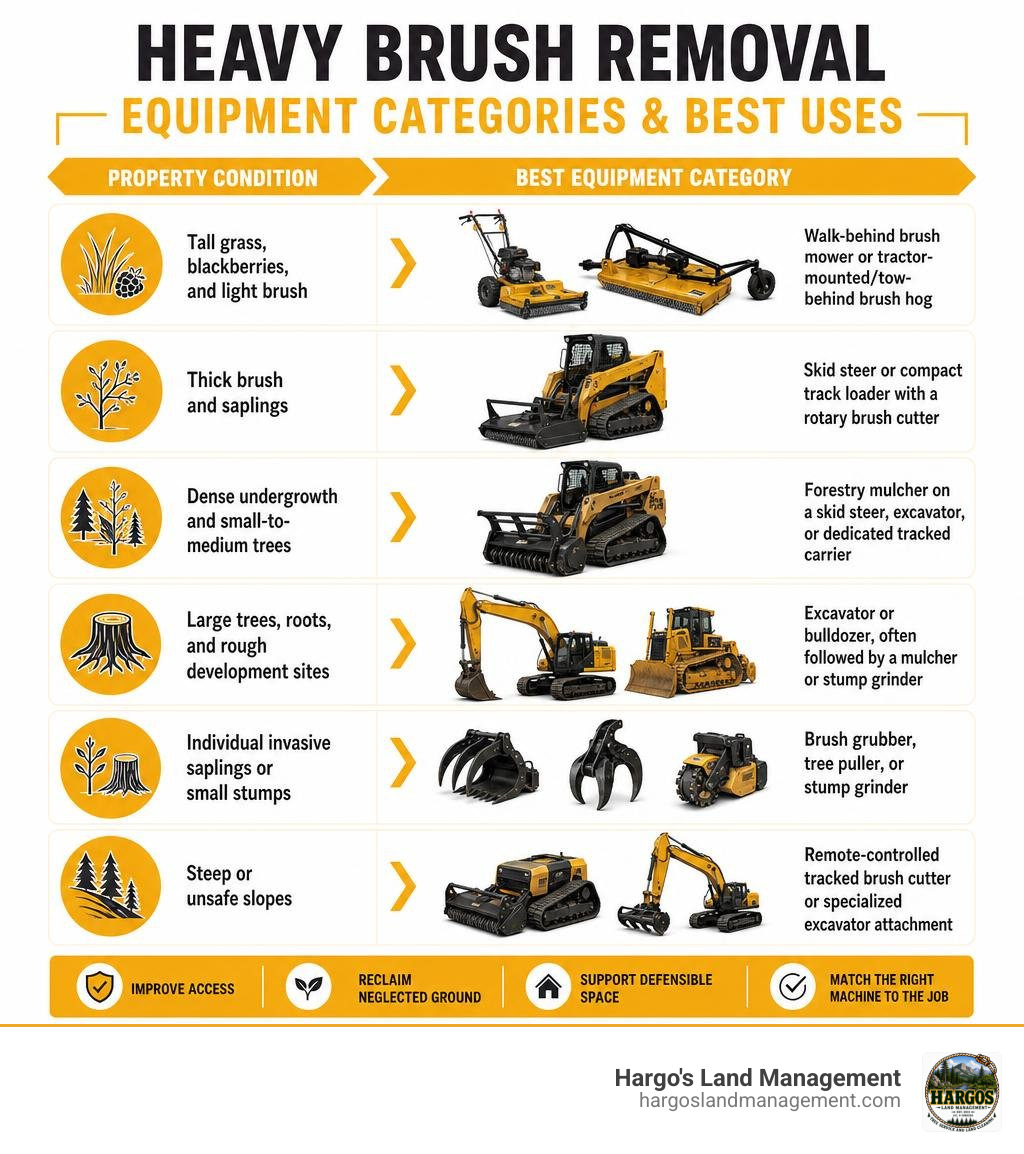
Heavy brush removal equipment should match the size of the vegetation, the terrain, and the result you need. For most large rural properties, the quick answer is:
| Property condition | Best equipment category |
|---|---|
| Tall grass, blackberries, and light brush | Walk-behind brush mower or tractor-mounted/tow-behind brush hog |
| Thick brush and saplings | Skid steer or compact track loader with a rotary brush cutter |
| Dense undergrowth and small-to-medium trees | Forestry mulcher on a skid steer, excavator, or dedicated tracked carrier |
| Large trees, roots, and rough development sites | Excavator or bulldozer, often followed by a mulcher or stump grinder |
| Individual invasive saplings or small stumps | Brush grubber, tree puller, or stump grinder |
| Steep or unsafe slopes | Remote-controlled tracked brush cutter or specialized excavator attachment |
For El Dorado County landowners, the goal is often bigger than making a property look tidy. Clearing dense vegetation can improve access, reclaim neglected ground, and support defensible space work around homes and outbuildings.
The right machine can reduce heavy fuels without tearing up more soil than necessary. The wrong one can leave stumps, damage the ground, bog down in brush, or create an avoidable safety risk. This guide compares the major equipment options so you can make a practical choice before renting, buying, or scheduling professional clearing.
Main Categories of Heavy Brush Removal Equipment
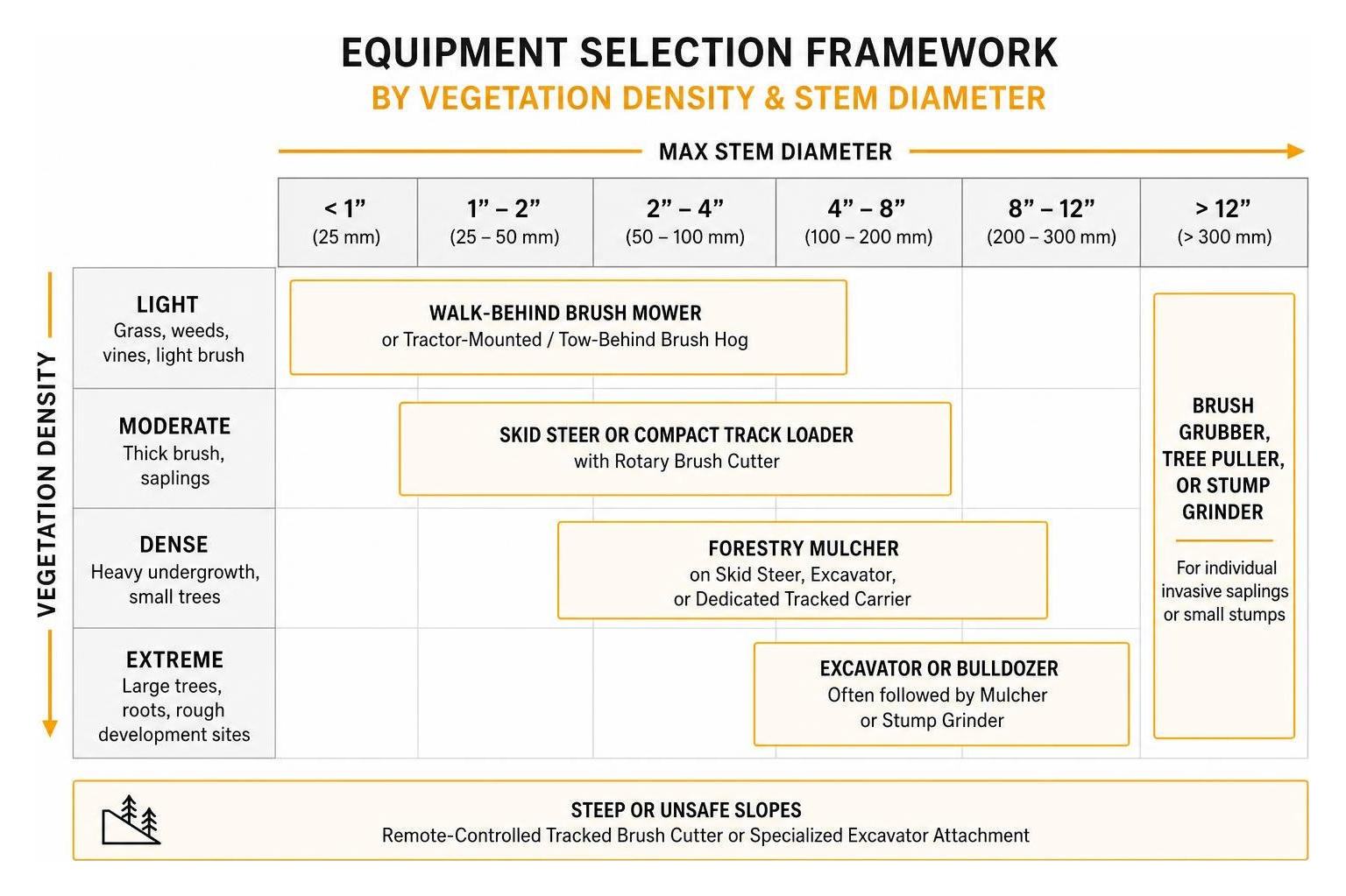
When tackling overgrown acreage, selecting the right category of heavy brush removal equipment depends on three primary variables: vegetation density, maximum trunk diameter, and the capabilities of your host machinery. Putting a light rotary cutter into 8-inch cedar trees will destroy the deck, while using a massive bulldozer to clear light blackberry vines is an expensive way to strip away precious topsoil.
Heavy Duty Machinery vs Compact Track Loader Attachments
For large-scale clearing, full-sized heavy machinery and compact host loaders represent the two dominant machinery platforms:
- Bulldozers: Earthmoving powerhouses built for pure push capability. Using heavy front blades, bulldozers can shear off brush at ground level or knock down whole trees using raw force (the pushover technique). However, they disturb the soil heavily, leave massive root balls exposed, and require secondary processing (such as burning or hauling) to manage cleared debris.
- Excavators: Excavators offer incredible reach and precision. Fitted with thumb attachments, heavy hydraulic shears, or hydraulic mulching heads, excavators allow operators to clear steep banks, pick out target trees, and lift material clear of ditches. They are ideal for selective clearing without disturbing surrounding soil.
- Skid Steers & Compact Track Loaders (CTLs): Tracked or wheeled skid steers are the most versatile land management tools available today. When paired with high-flow hydraulic attachments, a compact track loader operates in tight woods, maneuvers around structures, and carries high-torque cutting units. Tracked loaders distribute their weight over wide rubber tracks, reducing ground pressure in mud or soft earth.
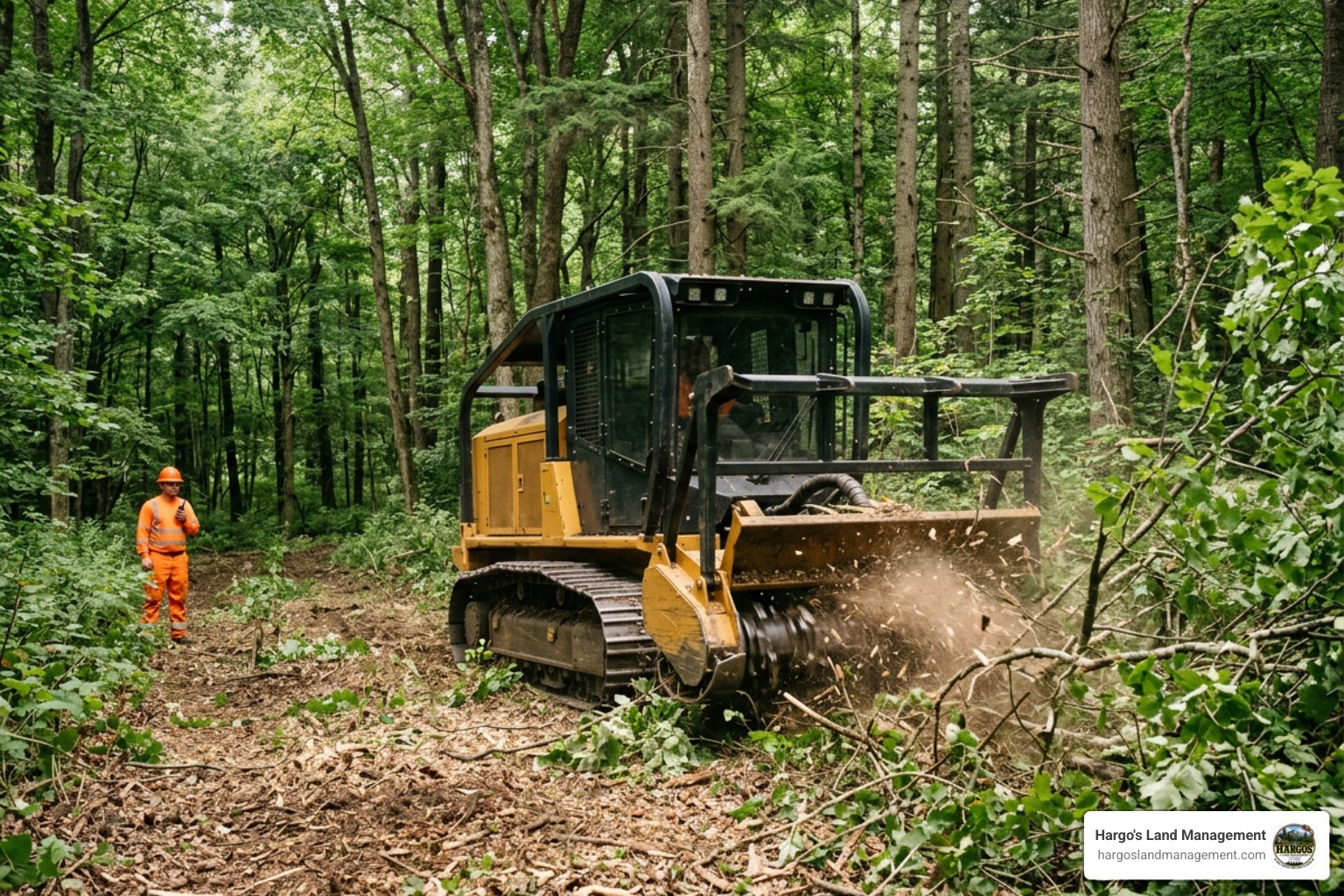
- Dedicated Forestry Mulchers: Purpose-built mulching carriers feature high-horsepower engines (often 100 to 300+ HP) direct-piped to heavy front shredding drums. They are designed specifically for heavy forest underbrush and rapid land clearing.
Walk-Behind, Tow-Behind, and Remote Heavy Brush Removal Equipment
For properties with lighter growth or tight access, dedicated mobile cutting rigs provide agility without requiring a multi-ton host loader:
- Walk-Behind Brush Mowers: Self-propelled walk-behind units operate much like heavy-duty lawnmowers on aggressive tractor tires. Powered by gas engines ranging from 10 to 20 HP, these units easily chop down tall weeds, dense brambles, and woody saplings up to 3 inches thick in areas accessible on foot.
- Tow-Behind Brush Hogs: Pulled behind a utility tractor or heavy-duty ATV/UTV, tow-behind brush hogs use PTO (Power Take-Off) or independent engines to sweep through large fields, pastures, and fence lines. They excel at processing high volumes of grass and light brush up to 3 inches in diameter across flat, open acreage.
- Remote-Controlled Robotic Brush Cutters: Steep embankments, drainage channels, and high-risk inclines require specialized machinery to keep operators safe. High-performance models like the LV 800 PRO Diesel-Powered Robotic Brush Cutter with Remote Control utilize 74 HP turbocharged engines and low-center-of-gravity tracked undercarriages to navigate slopes up to 60 degrees. Featuring remote operating ranges up to 100 meters, expandable track widths (from 151 cm to 191 cm), and lateral hydraulic tool positioning, these remote units eliminate the severe roll-over hazard associated with riding machinery on mountain slopes.
Matching Equipment Capabilities to Dense Forests vs Lighter Brush
Selecting heavy brush removal equipment requires balancing machine force against the material you need to shred or extract.
Hydraulic Flow Rates and Horsepower Requirements
If you plan to run hydraulic attachments on a skid steer, tractor, or excavator, performance comes down to hydraulic fluid flow (measured in Gallons Per Minute or GPM) and operating pressure (measured in PSI). Hydraulic horsepower determines how quickly attachment blades spin, how fast they recover after striking dense wood, and whether the head will stall out when pushed into heavy timber.
Hydraulic power is calculated using GPM and PSI. Most compact equipment falls into two hydraulic performance brackets:
- Standard Flow (14 to 25 GPM): Operates basic rotary cutters, light augers, and small stump grinders suitable for grass, brush, and saplings under 4 inches in diameter.
- High Flow (26 to 45+ GPM at 3,000 to 4,200 PSI): Drives industrial forestry drum mulchers, multi-spindle cutters, and heavy-duty rotary cutters capable of chewing through softwoods up to 10 inches thick.
High-output attachments feature direct-drive radial piston motors. Units like the Full-Size Heavy-Duty X-Series – Brush Wolf feature Eskridge bearing housings with massive 3.75-inch shaft diameters, continuous seam-welded deck frames, and integrated relief valves designed to absorb severe torque spikes when cutting through heavy brush.
High-Flow Attachments for Skid Steers and Excavators
Transforming a skid steer or mini excavator into an efficient brush-clearing system requires matching the attachment head to your specific clearing strategy:
- Rotary Brush Cutters: Standard rotary cutters use two to four swinging blades attached to a heavy rotating disc or blade carrier. The centrifugal force throws blades outward to slice through vegetation. Commercial models like the 72-inch Erskine Extreme HD Rotary Brush Mower | Cutting Width 72″ | 25-45 GPM – Ripping It Outdoors use 697-lb blade carriers operating at blade tip speeds near 15,700 feet per minute. Constructed with 1/2-inch AR400 steel skid shoes and 1/4-inch deck frames, these high-flow attachments shred softwoods up to 10 inches thick while incorporating integrated carbide stump-grinding teeth to level leftover ground-level wood.
- Forestry Drum Mulchers: Drum mulchers feature a horizontal cylinder studded with carbide teeth or knife blades rotating at high RPM. As the drum moves forward, it grinds standing trees, heavy brush, and fallen logs directly into a fine mulch blanket. Mulching leaves organic matter in place, stabilizing topsoil and eliminating debris piles without burning or hauling.
- Disc Mulchers: Disc mulchers feature a heavy steel flywheel fitted with perimeter cutting teeth. The massive inertia of the spinning disc acts like a flywheel saw, allowing operators to drop standing trees instantly with the high-speed outer rim and mulch them down using top-mounted teeth.
- Excavator Rotary Cutters: Mid-size and mini excavators equipped with dedicated cutter attachments like the Heavy-Duty X-Series – Brush Wolf allow landowners to reach down steep ravines, cut over fence lines, and shear material up to 6 inches thick. Operating across hydraulic flow ranges from 14 to 37 GPM, these excavator-mounted decks offer targeted reaching power that skid steers cannot match.
Targeted Clearing: Root Extraction, Stump Grinding, and Wide-Pass Cutting
Not every land clearing job requires grinding entire stands of forest into mulch. Selective property maintenance, pasture reclamation, and invasive species control require targeted extraction tools.
When clearing brush, deciding whether to cut vegetation at ground level or remove root systems entirely impacts long-term maintenance:
- Brush Grubbers and Tree Pullers: Invasive saplings and taproot-heavy brush like buckthorn, mesquite, or wild olive will quickly re-sprouting if cut down at ground level. Heavy metal-jawed brush grubbers attach to trucks, tractors, or ATVs via tugger chains. As the vehicle pulls forward, the steel jaws bite into the sapling trunk, popping the tree and its entire root ball cleanly out of the ground. Hydraulic tree-puller attachments mounted on skid steers perform the same task instantly from the cab, grabbing stem bases and pulling out roots without digging large holes.
- Wide-Pass Multi-Spindle Cutters: When managing wide pastures, rights-of-way, or fire breaks, single-spindle mowers can slow down operations. Specialized wide-pass units such as the Closed Front / Multi-Spindle Series – Brush Wolf use dual hydraulic motors driving multi-spindle blade systems. Delivering a 90-inch (7.5-foot) cutting width and built with continuous 1/4-inch steel decks, high-flow multi-spindle decks can clear woody material up to 5 inches thick in a single pass.
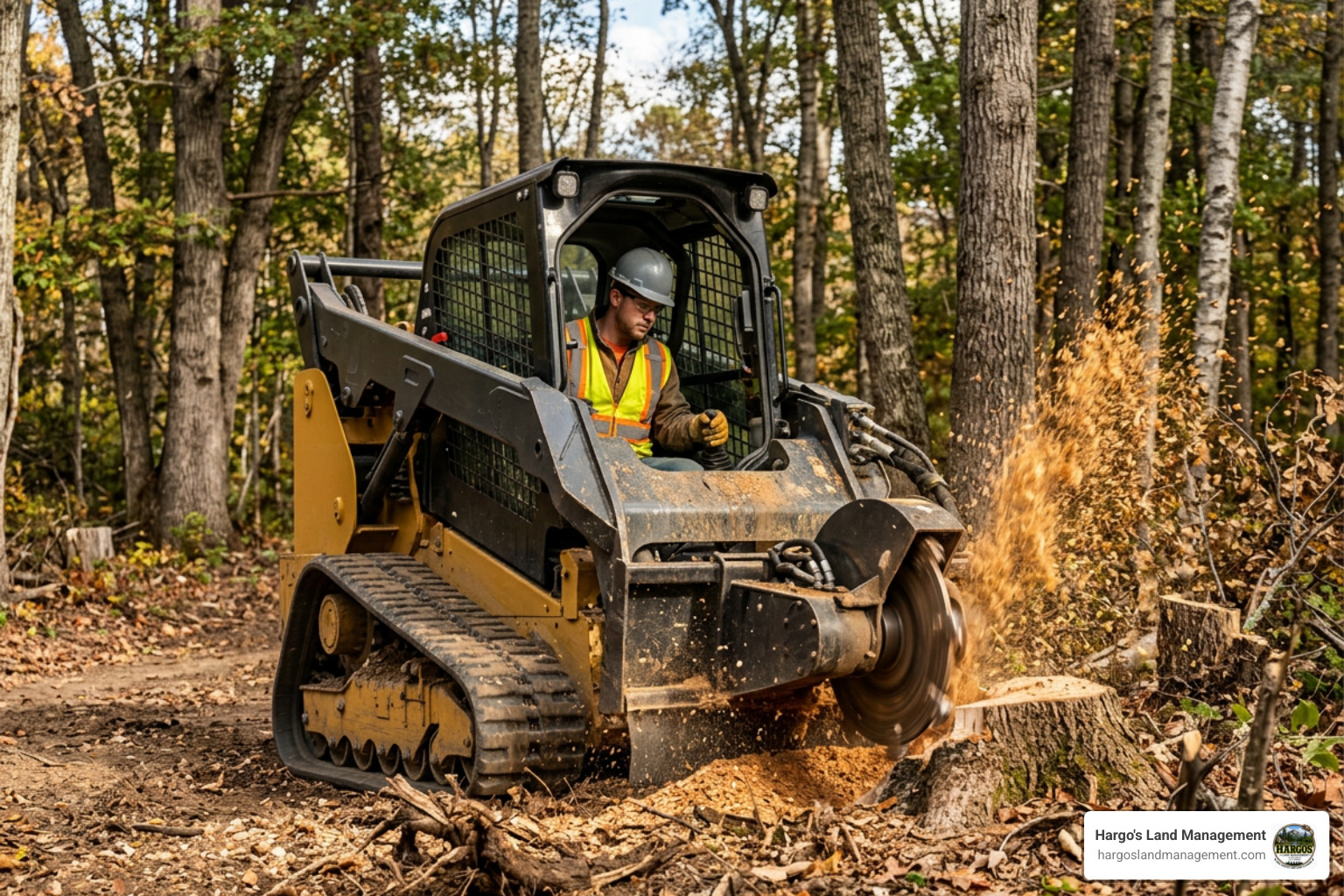
- Stump Grinders: Leaving high stumps behind after tree felling creates trip hazards, damages tractor mower decks, and invites pest infestations. Mechanical stump grinders feature high-speed steel wheels lined with carbide teeth that chew stumps down 6 to 12 inches below ground level, turning stubborn wood into mixed mulch.
Key Factors When Buying Heavy Brush Removal Equipment Attachments
Investing in heavy brush removal equipment requires evaluating your host machine’s physical specs, operating environment, and long-term project needs.
Before purchasing or renting clearing attachments, run through these primary operational metrics:
- Machine Weight and Loader Capacity: High-flow brush cutters and drum mulchers are heavy attachments. A 72-inch rotary mower can weigh between 1,700 and 2,300 lbs. If your skid steer’s Operating Capacity (ROC) is under-sized, lifting a heavy attachment on steep or uneven terrain will compromise front-end stability and tipping margins.
- Terrain Slopes and Surface Soil: Tracked machinery provides superior traction and ground flotation on soft ground, mud, and loose rock. Wheeled loaders offer faster travel speed on firm ground, but bog down easily in wet terrain or steep inclines.
- Debris Disposal Strategy: Consider what will happen to vegetation after it is cut. Bulldozing creates massive debris piles requiring burn permits or expensive hauling. Mulching grinds vegetation into soil cover on-site, supporting erosion control and retaining moisture.
- Personal Protective Equipment (PPE) & Machine Cab Safeguards: High-speed brush cutters and disc mulchers can hurl rocks, wood splinters, and metallic debris up to 300 feet. Host machinery must be equipped with impact-resistant polycarbonate safety glass (e.g., 1/2-inch Lexan doors), protective FOPS/ROPS cages, and wire mesh screens. Operators working around machinery must wear hard hats, high-visibility vests, hearing protection, and safety glasses.
Equipment Maintenance and Blade Replacement Best Practices
Heavy land clearing subjects tools to intense impact, high heat, and abrasive soil contact. Following a strict maintenance schedule protects your equipment investment and prevents sudden hydraulic failures:
- Blade Care & Hardox 500 Steel Maintenance: Inspect cutting edges daily. Commercial rotary cutters use heavy drop blades or flat blades manufactured from high-impact Hardox 500 or AR400 abrasion-resistant steel. Dull blades drag down engine RPMs, double fuel consumption, and overheat hydraulic oil. Sharpen or replace dull blades, and ensure dual-blade carriers remain balanced to prevent severe bearing vibration.
- Daily Grease Protocols: Lubricate all main bearing housing grease points, drive shafts, and pivot pins every 4 to 8 operating hours. Fresh grease purges out dirt, grit, and fine wood dust that would otherwise ruin roller bearings.
- Gearbox Seal Protection: Wire, fencing, and woody vines often wrap around rotating lower drives. Ensure your attachment deck features a welded seal guard collar to keep foreign debris from damaging gearbox seals and leaking hydraulic fluid.
- Case Drain Line Installation: High-flow hydraulic motors require a dedicated 3/8-inch third hydraulic line called a case drain line. The case drain returns excess pressure build-up directly back to the host machine’s hydraulic reservoir. Operating high-torque radial piston motors without a clear case drain line will blow out motor shaft seals instantly.
- Hose Routing and Routing Clamps: Check hydraulic lines for chafing or pinching. High-grade attachments use dedicated hose guides, protective STAUFF clamps, and outer sleeve wraps to prevent hoses from snagging on standing brush.
Frequently Asked Questions About Heavy Brush Removal
What hydraulic GPM is required to operate heavy brush attachments?
Standard flow attachments require between 14 and 25 GPM, which is suitable for clearing light brush, weeds, and small saplings under 4 inches in diameter. High-flow attachments demand between 26 and 45 GPM at operating pressures from 3,000 to 4,200 PSI. High-flow hydraulic systems are necessary for powering forestry drum mulchers, disc mulchers, and extra-wide rotary cutters capable of processing timber up to 10 inches thick.
Is it better to buy or rent heavy brush clearing machinery?
Renting makes economic sense for short-term, one-off property improvements lasting a few days to a week, eliminating maintenance, insurance, and initial capital costs. Buying is ideal for landowners managing large acreage, agricultural properties, or long-term forestry tracts requiring continuous maintenance. However, high-flow attachments can cost between $7,000 and $35,000+, while heavy host loaders cost significantly more—making professional clearing services a cost-effective alternative for complex projects.
How does heavy brush clearing create fire safety defensible space?
Heavy brush clearing removes ladder fuels—dense underbrush, thickets, dead wood, and low-hanging branches that allow ground fires to climb high into tree canopies. Masticating brush into wood fragments or clearing high-density thickets creates clean fuel breaks around structures and property borders. Maintaining low fuel loads near buildings slows advancing wildfires and gives firefighters safe access to defend homes.
Conclusion
Choosing the right heavy brush removal equipment depends on matching your property’s terrain, vegetation density, and long-term land goals to the right machinery category. Whether using self-propelled walk-behind mowers for light fence lines, high-flow forestry mulchers to reclaim overgrown pastures, or remote-controlled slope mowers for dangerous ravines, selecting the right equipment helps clear land efficiently while preserving topsoil and machine life.
If tackling dense forest growth, heavy tree removal, or steep slope management feels overwhelming, working with experienced professionals saves time and avoids equipment wear. At Hargo’s Land Management, our team brings local expertise, heavy clearing equipment, and fire-safety focus to every project across El Dorado County. Contact us today for a free on-site estimate and let our team handle your heavy clearing, pasture reclamation, and defensible space clearing services safely and effectively.
CUSTOMER REVIEWS & TESTIMONIALS
We strive to exceed your expectations. See what our customers have to say.















CONTACT US TODAY
Serving El Dorado and Surrounding Counties
Locally owned and operated since 2013. Use our live chat support to get in touch about your land management needs today.
Request a free evaluation and estimate by completing our online form or book an on-site appointment.
El Dorado County: El Dorado Hills, Cameron Park, Shingle Springs, Coloma, Placerville, Camino, Pollock Pines, South Lake Tahoe and more...
Amador County: Jackson, Ione, and Surrounding Towns
Sacramento County: Sacramento and Surrounding Cities
Placer County: Roseville, Rocklin, Auburn, and Everything In Between
Nevada County: Penn Valley, Nevada City, Grass Valley