
Understanding Defensible Space Zones and Tree Spacing Rules
Defensible Space Requirements Start at Your Home
Defensible space requirements create a wildfire safety buffer around your home by removing or changing vegetation that could carry embers, heat, or flames to the structure. In California, the baseline is generally 100 feet from each structure or to the property line, but local rules may be stricter.
Start closest to the house and work outward:
- Zone 0: 0-5 feet – Use noncombustible materials such as gravel, stone, pavers, or concrete. Remove firewood, bark mulch, dry debris, and flammable plants.
- Zone 1: 5-30 feet – Keep plants spaced, watered when appropriate, and free of dead material. Eliminate branches near roofs and chimneys.
- Zone 2: 30-100 feet – Reduce continuous fuels by mowing dry grass, removing dead brush, pruning lower limbs, and separating trees and shrubs.
For El Dorado County homeowners, the first 5 feet matter most. Wind-blown embers can land long before the main fire arrives, so a clean, noncombustible perimeter helps prevent a small ignition near the wall, deck, or fence from becoming a house fire.
Defensible space is not clear-cutting. The goal is to break up fuel, remove ladder fuels that let fire climb from shrubs into tree canopies, and give firefighters a safer area to work. Tree spacing must increase on steeper slopes because fire travels uphill faster.
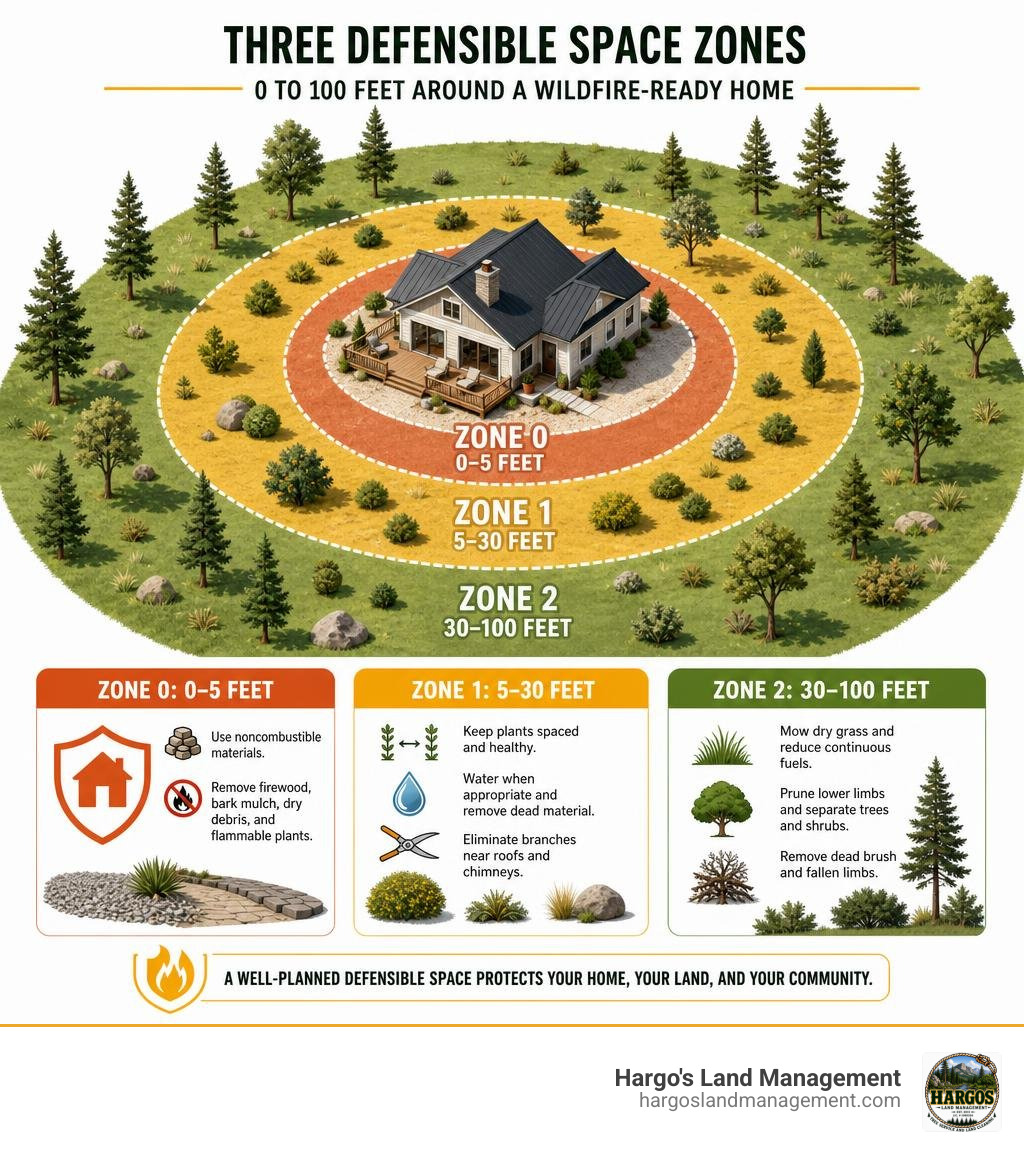
Defensible space requirements terms at a glance:
Defensible Space Requirements: The Three Primary Zones Explained
Living in the Sierra Nevada foothills means coexisting with wildland beauty and seasonal wildfire activity. When a wildland fire sweeps through a canyon, it threatens structures in three distinct ways: flying ember storms, radiant heat exposure, and direct flame impingement. Managing the fuel load across the complete 100-foot Home Ignition Zone (HIZ) systematically addresses each of these threats.
State baseline standards, including the CAL FIRE defensible space guidelines, divide the ground surrounding your living spaces into three distinct management radii:
| Zone | Radius | Primary Objective | Key Requirements |
|---|---|---|---|
| Zone 0 | 0 to 5 feet | Ember defense & structure isolation | Non-combustible hardscaping, zero bark mulch, clean gutters, no attached wood fencing. |
| Zone 1 | 5 to 30 feet | Flame suppression & radiant heat buffer | Lean and green plantings, 10-ft tree canopy separation, 10-ft chimney clearance. |
| Zone 2 | 30 to 100 feet | Fuel reduction & fire behavior modification | Mowed grasses (<4 in.), ladder fuel removal, 3-in. max needle litter, outbuilding clearance. |
By modifying fuels methodically outward from your foundation, we create an environment where approaching surface fires drop in intensity and starve for fuel before they can ever reach your siding.
Zone 0: The Immediate Ember-Resistant Zone (0–5 Feet)
Zone 0 is ground zero for residential wildfire protection. Post-fire investigations consistently reveal that the overwhelming majority of destroyed homes are ignited not by a towering wall of flame, but by wind-driven embers landing in combustible debris right against the structure. Embers find dry leaves trapped in gutters, slip beneath deck planks, or land in dry bark mulch next to wood siding.
Creating a non-combustible perimeter requires straightforward, decisive steps:
- Remove all organic mulch: Replace wood chips, cedar shavings, gorilla hair, and pine needle beds with decorative river rock, decomposed granite, pea gravel, or stone pavers.
- Eliminate foundation plantings: Remove flammable foundation shrubs, climbing vines, arborvitae, and juniper bushes situated beneath windows, eaves, or decks.
- Clear roof and eave debris: Routinely sweep away dead pine needles and leaves from roofs, valleys, and rain gutters.
- Relocate stored items: Move firewood cords, scrap lumber piles, outdoor patio furniture with fabric cushions, and plastic trash cans out of Zone 0 entirely.
- Isolate attached fencing: Replace wooden fence sections and gates that directly touch the house with non-combustible metal or composite materials for the first 5 feet to stop fire from tracking along the fence straight into your home.
Zone 1: The Lean, Clean, and Green Zone (5–30 Feet)
Zone 1 extends from 5 feet out to 30 feet from your home’s exterior walls and all attached decks. The operational goal here is to keep fuels so well-managed and hydrated that an advancing fire cannot produce sufficient radiant heat or flame length to break window glass or ignite exterior walls.
To reduce wildfire dangers in this intermediate perimeter:
- Keep plantings carefully arranged in isolated garden beds separated by non-combustible pathways.
- Prune all mature trees to guarantee a minimum 10-foot clearance between branch tips and chimney flues or stovepipe outlets.
- Maintain a minimum 10-foot horizontal separation between the outer perimeter of tree canopies.
- Keep lawn areas well-irrigated, and pull all dead leaves, dry twigs, and deadwood out of ornamental garden beds.
- Establish 10 feet of bare mineral soil clearance around Liquid Propane Gas (LPG) storage tanks, supplemented by an additional 10-foot outer buffer free of flammable brush.
Zone 2: The Reduced Fuel and Extended Zone (30–100 Feet)
Zone 2 spans from 30 feet out to 100 feet from your living spaces (or to your legal property line). The purpose of this broad band is to interrupt continuous wildland fuel continuity, slowing the fire’s forward rate of spread and forcing dangerous crown fires down to mild surface fires.
In Zone 2, comprehensive brush and land clearing transforms dense, overgrown brush fields into open, park-like landscapes:
- Mow or string-trim annual grasses and invasive weeds down to a maximum height of 4 inches across the entire zone.
- Thin out dense brush stands (such as manzanita and chamise) into small, separated clusters.
- Limit accumulated ground needles, leaf litter, and fallen bark to a maximum depth of 3 inches across the soil surface—you do not need to scrape Zone 2 down to bare dirt, which causes severe winter erosion.
- Remove all standing dead trees, fallen logs, and dead branch material.
- Store cordwood and timber piles here, ensuring at least 10 feet of bare mineral soil surrounds each pile.
Tree and Shrub Spacing Rules for Wildfire Fuel Reduction
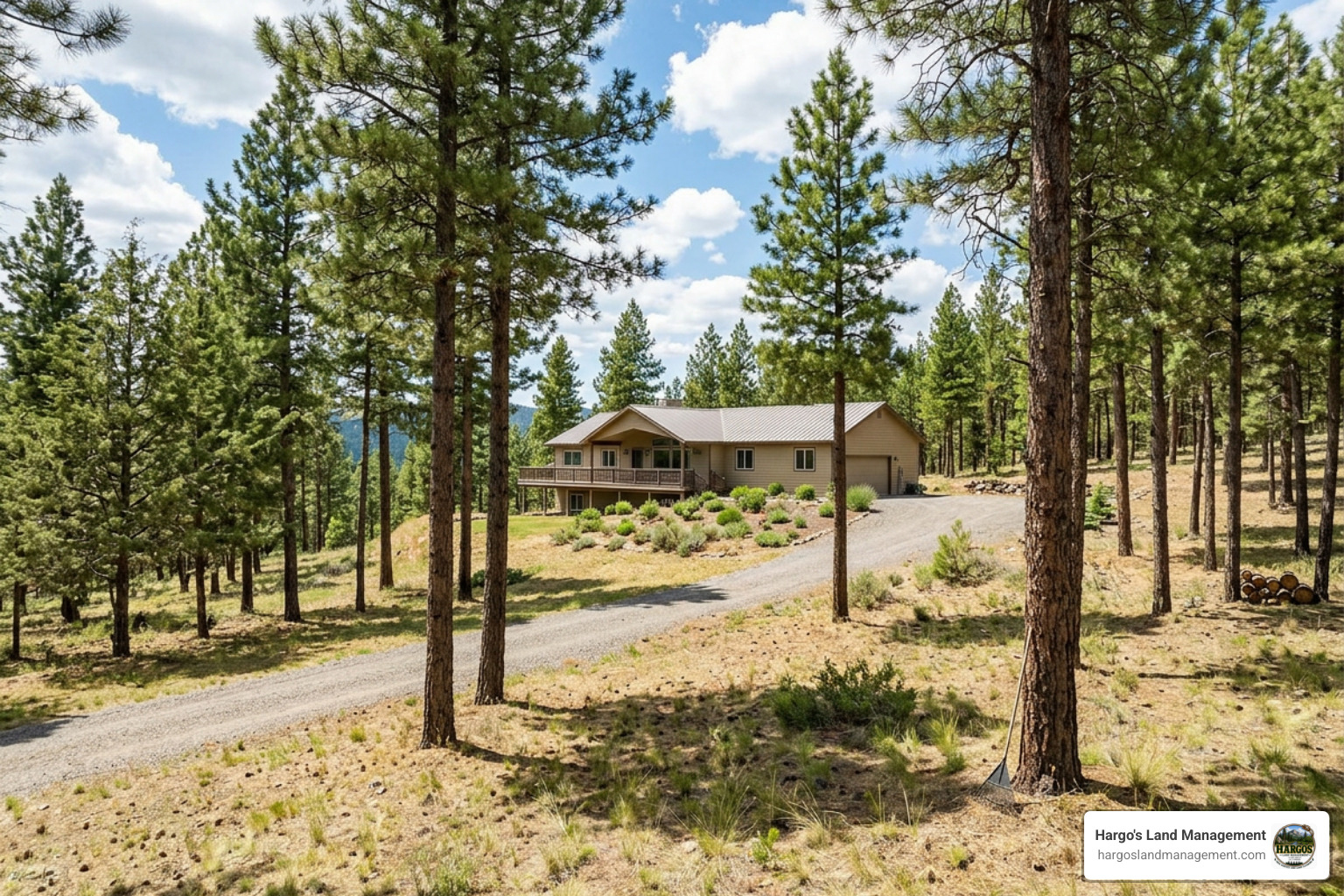
A healthy forest features natural gaps. When tree crowns interlock across a hillside, a fire can spread unchecked through the treetops as an active crown fire, producing extreme heat and sending ember showers miles downwind. By creating canopy separation and managing lower vegetation, we remove the fuel bridges that allow flames to climb.
When dead, diseased, or overcrowded trees threaten your property layout, professional hazardous tree removal eliminates the heavy fuels that standard pruning cannot resolve.
Vertical Clearance and Ladder Fuel Elimination
Ladder fuels are intermediate-height plants—such as tall grasses, native shrubs, juvenile saplings, and low-hanging branches—that allow a ground fire to climb up into mature tree canopies. Eliminating ladder fuels keeps wildland fires burning low to the ground where they can be quickly managed.
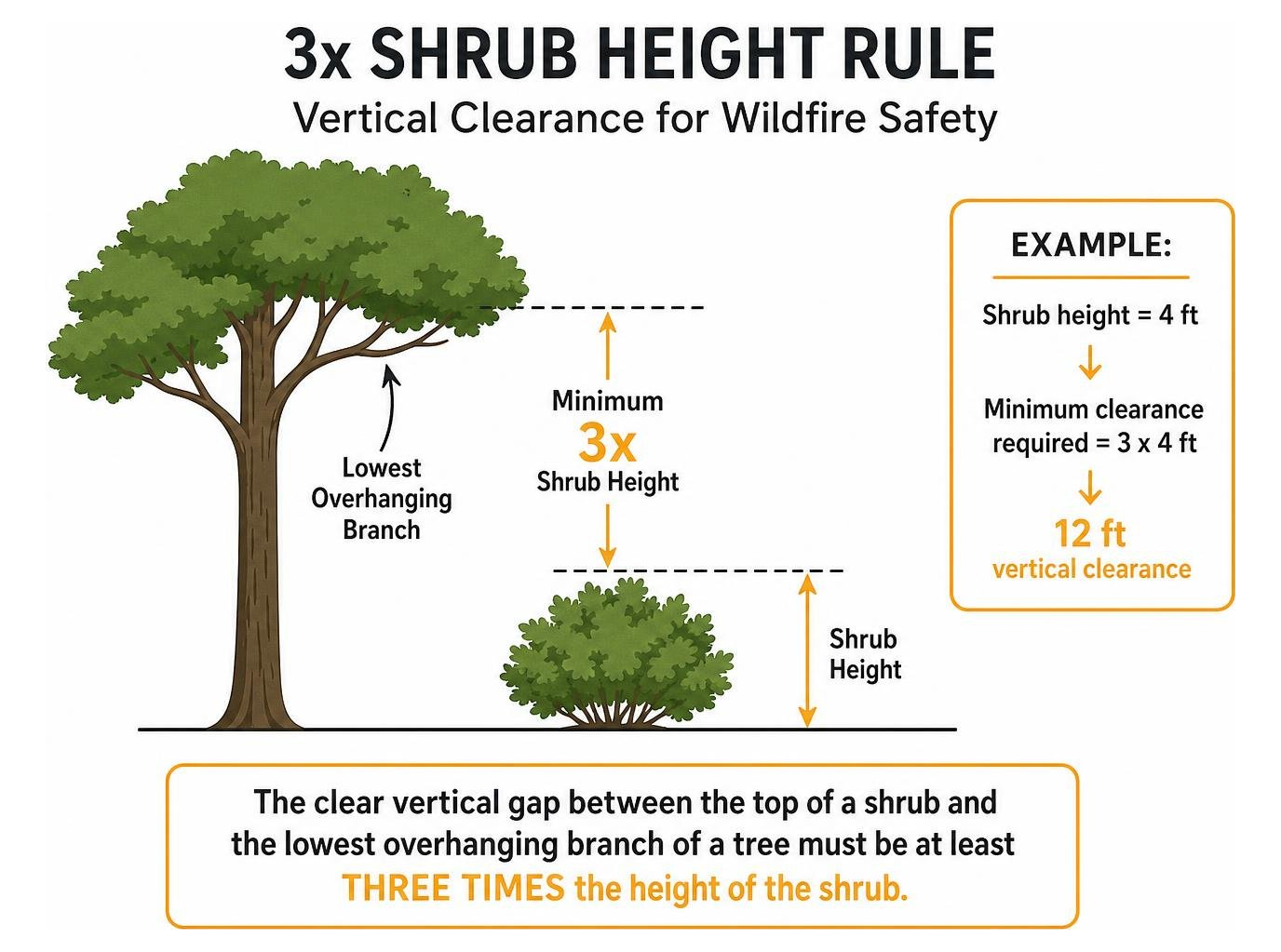
To maintain vertical clearance:
- Prune mature tree branches: Remove all lower tree limbs up to at least 6 feet from ground level (or one-third of the total tree height for trees under 18 feet tall).
- Apply the 3x vertical spacing formula: The clear vertical gap between the very top of a shrub and the lowest overhanging branch of a tree must equal at least three times the height of the shrub.
- Calculation Example: If an ornamental shrub is 4 feet tall, you must maintain at least 12 feet of vertical clearance between the top of that shrub and the lowest tree branch directly overhead ($4\text{ ft} \times 3 = 12\text{ ft}$). If the clearance is less, prune the tree limb up or remove the shrub.
When executing complex canopy thinning across your property, consulting an isa certified arborist ensures your trees maintain long-term structural vitality while meeting defensible space standards.
Horizontal Spacing Adjustments Based on Slope Gradient
Fire preheats fuels uphill ahead of the flame front, causing flames to spread significantly faster and taller on slopes compared to flat ground. Because of this natural phenomenon, both tree canopy spacing and shrub grouping distances must expand as ground slope increases.
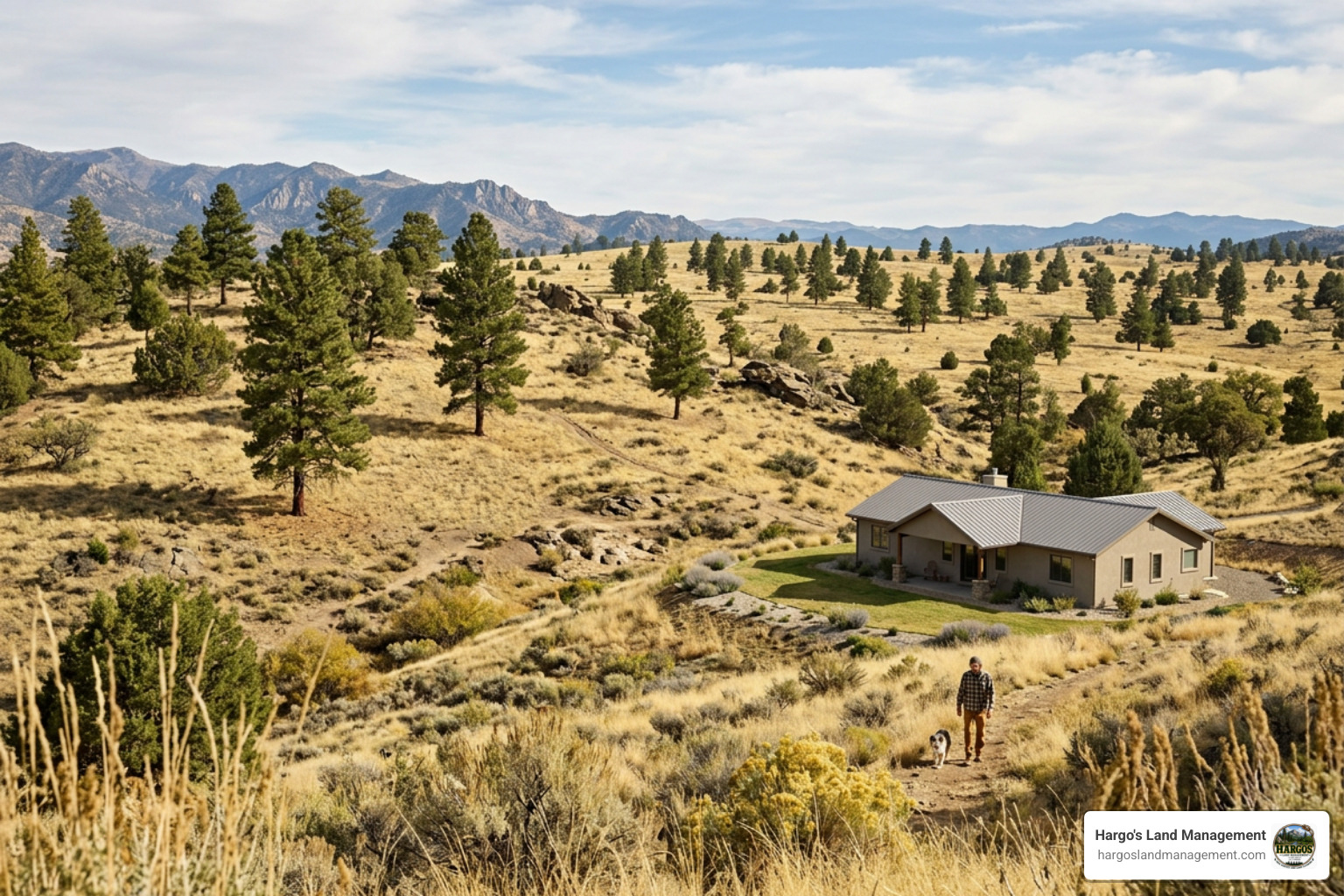
Per regional standards like the Ventura County defensible space standards and CAL FIRE guidelines, horizontal spacing scales across three primary slope classes:
| Terrain Slope Class | Slope Percentage | Tree Canopy Edge-to-Edge Spacing | Shrub Grouping Separation Distance |
|---|---|---|---|
| Mild / Flat | 0% to 20% grade | Minimum 10 feet separation | 2 times the height of the shrub |
| Moderate | 20% to 40% grade | Minimum 20 feet separation | 4 times the height of the shrub |
| Steep | Greater than 40% grade | Minimum 30 feet separation | 6 times the height of the shrub |
Shrub Spacing Example: On a steep 45% slope, a patch of ceanothus brush measuring 3 feet in height requires a horizontal separation of 18 feet ($3\text{ ft} \times 6 = 18\text{ ft}$) from the next neighboring shrub cluster.
State Regulations, Home Hardening, and Year-Round Maintenance
Effective wildfire defense pairs proper vegetation buffers with structural home hardening. When you combine fire-resistant materials on your structure with proactive fuel thinning, your home is far better equipped to survive extreme wildfire conditions.
Legal Defensible Space Requirements Across Different States
Defensible space regulations are enforced across wildfire-prone western states through specific statutory codes, building rules, and financial assistance programs:
- California: Mandated under California Public Resources Code (PRC) Section 4291 and Government Code 51182. State law requires 100 feet of managed defensible space around all habitable buildings, with Zone 0 regulations specifically targeting the 0–5 foot ember zone. Local jurisdictions can impose stricter rules; for instance, some counties require 50 feet of clearance in Zone 1.
- Colorado: Colorado structures its wildfire defense around the Home Ignition Zone framework (Zone 1: 0–5 ft, Zone 2: 5–30 ft, Zone 3: 30–100 ft). To assist property owners with out-of-pocket mitigation costs, the state offers the Wildfire Mitigation Income Tax Credit for qualifying residential fuel reduction expenses.
- Oregon: Governed by the comprehensive Oregon Model Defensible Space Code, which aligns with statutory provisions in ORS Chapter 476. The Oregon State Fire Marshal provides standardized hazard-level tiers (Moderate: 5–30 ft, High: 31–50 ft, Extreme: 51–100 ft) alongside free on-site property defensible space assessments.
Key Defensible Space Requirements for Home Hardening
Hardening your home prevents wind-blown embers from entering structural voids:
- Vent Screen Assemblies: Cover all attic, gable, soffit, eave, and crawlspace foundation vents with 1/8-inch corrosion-resistant wire mesh. Standard 1/4-inch hardware cloth allows burning embers to enter attic spaces.
- Roofing Systems: Ensure roof coverings have an explicit Class A fire rating (such as asphalt fiberglass composition shingles, slate, or concrete tile). Regularly replace missing or cracked shingles.
- Eaves and Soffits: Enclose open roof overhangs with non-combustible soffit materials to prevent swirling ember traps.
- Ground-to-Siding Vertical Gap: Maintain a minimum 6-inch vertical clearance between bare soil or hardscaping and the start of exterior wood or composite siding.
- Glazing: Install dual-pane or multi-pane windows with tempered glass, which resists breaking under high radiant heat loads.
Dry Season Vegetation Maintenance
Maintaining compliant defensible space during hot, dry summer months requires careful technique to prevent accidental equipment fires. Striking a hidden rock with a steel mower blade on dry August grass can generate sparks that instantly ignite dry fuel.
Routine seasonal weed abatement and property maintenance should follow these safety guidelines:
- Observe the 10:00 AM Rule: Complete all power equipment operations—such as mowing, brush cutting, and chainsaw work—before 10:00 AM. Avoid operating power equipment during high heat, low humidity, or Red Flag conditions.
- Choose String Trimmers Over Mowers: In dry, rocky foothill terrain, use heavy-duty nylon string trimmers rather than lawnmowers with steel blades.
- Keep Safety Gear on Hand: Always have a pressurized water extinguisher or garden hose connected and ready, alongside a round-point shovel, whenever operating power tools in Zone 2.
- Ongoing Vegetation Management: Water retained fire-resistant plantings deeply and prune dead twigs, seed pods, and dry fronds out of ornamental plants throughout the summer.
Frequently Asked Questions About Defensible Space
What is the 3x rule for vertical tree and shrub spacing?
The 3x rule is a fuel management formula designed to prevent surface fires from climbing into tree canopies via ladder fuels. It requires that the vertical gap between the top of any shrub and the lowest overhanging tree branch be at least three times the total height of that shrub. For example, a shrub that grows 5 feet tall requires 15 feet of open vertical space above it ($5\text{ ft} \times 3 = 15\text{ ft}$). If that clearance cannot be achieved, prune the lowest tree branches upward or relocate the shrub.
How do I maintain defensible space safely during hot and dry summer months?
Never use metallic lawnmowers in tall, cured grass during hot summer afternoons. To prevent accidental spark ignitions, finish all motorized weed trimming before 10:00 AM while morning relative humidity is higher. Use commercial-grade string trimmers with nylon line, keep water hoses and shovels on hand, and avoid mechanical clearing entirely on windy Red Flag days. You can watch our video defensible space before after to see compliant clearing techniques in dry foothill conditions.
What should I do if my 100-foot defensible space crosses a property line?
State defensible space mandates (including California PRC 4291) require clearing out to 100 feet from your structure or up to your legal property line—you cannot perform unauthorized work on a neighbor’s property. If your 100-foot buffer extends onto an adjacent parcel, talk with your neighbor to coordinate fuel management. If an adjacent lot is vacant or the owner is non-responsive, contact your local fire protection district. In cases where clearance cannot extend 100 feet, fire marshals may approve Alternate Means and Methods (AM&M), such as non-combustible exterior masonry walls or upgraded structural home hardening.
Conclusion
Protecting your property against wildfire is an ongoing process that requires seasonal care. By maintaining the 0–5 foot non-combustible buffer in Zone 0, thinning fuels across Zones 1 and 2, and following slope-adjusted canopy spacing guidelines, you establish a reliable barrier that protects your home and provides emergency crews with a safe perimeter to work.
At Hargo’s Land Management, we help property owners throughout El Dorado County—including Placerville, South Lake Tahoe, Cameron Park, and Pollock Pines—bring their land into full compliance with state and local fire standards. As a locally owned, fully licensed, bonded, and insured team, we provide free on-site property evaluations, rapid mobilization, and fire-safety-focused clearing.
Ready to protect your home and bring your parcel into full compliance? Contact our team today for a free on-site estimate and explore our professional defensible space clearing services to keep your property safe year-round.
CUSTOMER REVIEWS & TESTIMONIALS
We strive to exceed your expectations. See what our customers have to say.















CONTACT US TODAY
Serving El Dorado and Surrounding Counties
Locally owned and operated since 2013. Use our live chat support to get in touch about your land management needs today.
Request a free evaluation and estimate by completing our online form or book an on-site appointment.
El Dorado County: El Dorado Hills, Cameron Park, Shingle Springs, Coloma, Placerville, Camino, Pollock Pines, South Lake Tahoe and more...
Amador County: Jackson, Ione, and Surrounding Towns
Sacramento County: Sacramento and Surrounding Cities
Placer County: Roseville, Rocklin, Auburn, and Everything In Between
Nevada County: Penn Valley, Nevada City, Grass Valley